Text description provided by the architects
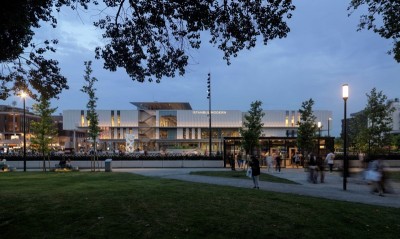
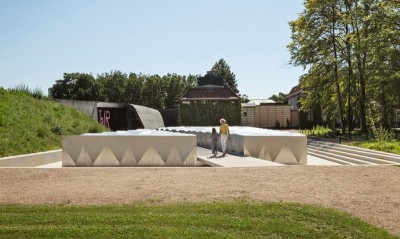
The ground beneath your feet is the roof of another profound world, as Underland puts it. The Concrete Palace, also known as the Museum Eye Art Palace of the Manchukuo Palace Museum in Changchun, is Jilin's first fair-faced concrete building with exposed finish, the largest fair-faced concrete building in the three northeastern provinces, and China's largest double-curved, thin-shell, long-span, earth-covered underground building. After six years of design and construction, it opened on International Museum Day, May 18, 2023. On the eve of May 1, 2017, the museum director, exhausted after more than twenty rounds of rejected schemes, asked the designer for a convincing proposal that could represent Changchun. The designer's career repeatedly features such emergency stories, and he gladly accepts the challenge; Changchun was unfamiliar and distant to him, so he began with fragments of the city. Changchun was once the most developed city in East Asia and remains an important industrial center, once exceptionally elegant and cultivating clivia. The city is fundamentally proud and optimistic, unwilling to lie flat. The Manchukuo Palace is not large, almost a transitional palace, yet its construction is refined: a big roof combined with Western classical forms, restrained and exquisite ornament. The white Northeast China Fall of History Exhibition Hall designed by master architect Qi Kang stands far at the northeast corner, its gentle pitched roof below the main ridge, deeply modest. The designer composed these fragments as an upper line of poetry. The future art palace should be even more modest, not altering the stable museum landscape; accordingly, it is hidden. Given that the palace and exhibition hall use conventional structures, the designer decided to introduce the long-span structure common in industrial architecture to create a vast interior that expresses the city's underlying pride. Elegant curves and a chain of symbolism, metaphor, and association convey the confidence of a great city seeking renewed glory in a new historical era. At the same time, the art palace is a contemporary expressionist building that liberates the mind from time's grip on daily life, allowing re-examination of history and memory and thus an understanding of the meaning of existence. The designer chose fair-faced concrete for its simple industrial quality, but rather than restraining the concrete within neat formwork, he returned to early expressionism of the 1930s, using familiar steel as formwork to shape the long-span double-curved thin-shell concrete dome. When the project architect worried that the interface coating was too thick and would obscure the carefully arranged board joints,, and bolt holes optimized through BIM, the designer replied that it was fine: looking at Eero Saarinen's concrete and Le Corbusier's mortar, the holes are not something we must express. The coating forms a transparent boundary on the concrete surface; in light, the concrete seems to have a halo, and as light changes the highlights pace along the curves, a restrained exuberance, no, an enchanting expressionism appears.




 Editor's Pick
 Latest Design