Text description provided by the architects
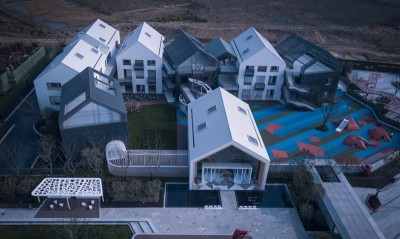
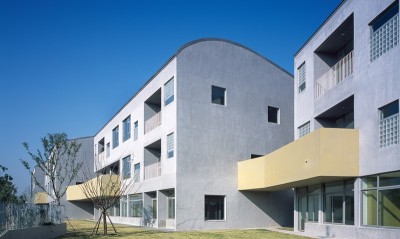
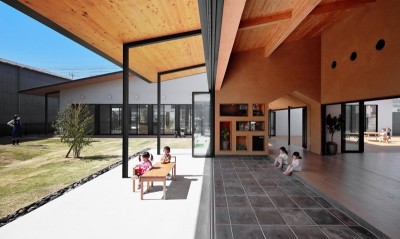
The Yiwu Montessori Early Childhood Education Center in Zhejiang is a 2019 adaptive reuse by ZAN Studio, the architectural sub-brand of A+D Design, that converts an abandoned tea house and courtyard into a daycare serving children from zero to six. The brief was nearly impossible: low budget, cramped space, an enclosed site and almost no infrastructure, and the old program of a static, retired leisure tea house had to be transformed into the dynamic, growing environment of a kindergarten. The three keywords painted on the gable wall, independent, brave and free, articulate the project's deeper polemic: against a generation raised on collectivism, safety and rule-following that has, the studio argues, suppressed creative instinct, this small retrofit aims to awaken self-discovery, adventure and freedom. The site on Xicheng Road in Yiwu originally comprised two dilapidated buildings and leftover open ground, with a narrow, gravel-scattered courtyard between them and no space adequate for children's running play. The architects rerouted movement through the middle: an open stair in the courtyard links the ground-floor open green to a second-floor circular platform, and a rainbow-shaped gate punches through the wall between courtyard and external lot. The strategy directly confronts the contradiction between limited open space and children's play instinct, creating two play levels and a complex of ground inner and outer courtyards plus an upper open loop. The multi-level, multi-loop plan rewards exploration based on children's behavioral patterns; running, chasing and adventuring become part of socialization. The studio notes that kindergartens are among the most strictly regulated building types in China, yet the rules quantify function, daylight and fire safety while rarely addressing the conditions under which a child's can actually be released. The project argues that homogeneous education space has accelerated Chinese childhood into efficiency and standardization, and that the architect's role is to push the boundary between regulation and freedom.




 Editor's Pick
 Latest Design