Text description provided by the architects
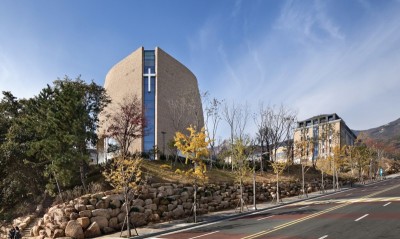
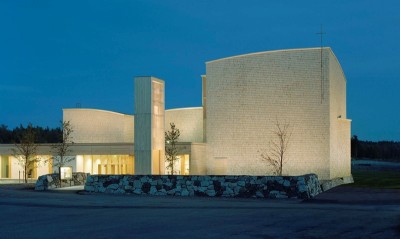
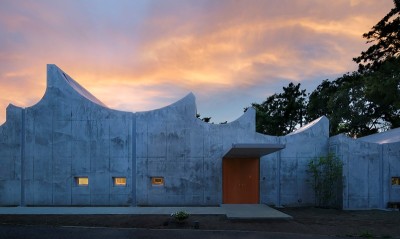
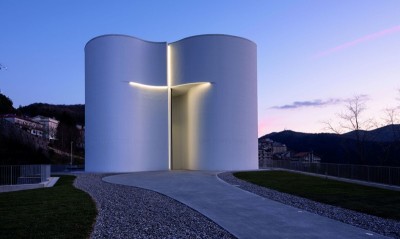
Built within the Sino-French Agricultural Science and Technology Park in Chengdu, a development conceived to distil the lifestyle and artistic atmosphere of the south of France, the so-called Shadowless Church is a small non-denominational chapel that treats light itself as the primary material. The design team, jointly led by Li Hui of WTD and Hong Dongtao of Shanghai Dachuan Architects, takes its cues from the impressionist light of Provence and from Le Corbusier's chapel at Ronchamp, where a traditional ecclesiastical typology was broken open in favour of expressive, almost abstract form. Rejecting conventional masonry, the church is imagined as a volume through which sunlight can pass: when beams of daylight strike the white vertical members, they resolve into visible columns of light, and those columns together compose a church that is itself made luminous. To make that idea structurally credible, the team refined the section from round bars to a 40-millimetre square profile, producing a field of upward light-columns that create the illusion of a floating dome suspended above the nave. The primary frame is a thin-wall steel grid at 240 by 240 millimetres, with thick-walled aluminium square tubes grounding the structure and thin-walled tubes hung by tension rods so that the load-bearing skeleton all but disappears. Cladding and structure merge, and interior and exterior interpenetrate. Because the building was delivered in roughly two months, aluminium square tube became the single material of construction: lightweight, seismic-resistant, corrosion-proof, green, and detailed so that no weld lines are visible at close range. At night the same envelope produces controlled inward-glow rather than spill, giving the chapel a quiet, refined presence within the lavender fields. Completed in August 2018 by Dachuan Architects, the project argues that pure whiteness and free interleaving of light can express both the sacred and the modern, and that beauty, form and soul must coexist if a building is to read as a poem.




 Editor's Pick
 Latest Design
 Best Idea