Text description provided by the architects
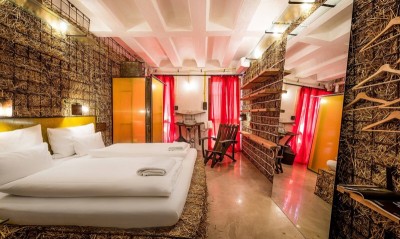
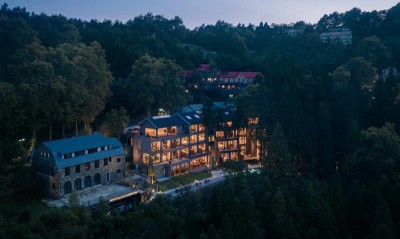
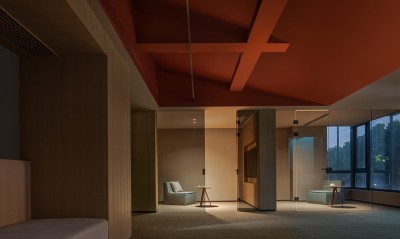
When the architect returns to the craftsman's role, setting aside electronic tools and relying on years of experience to control the built form directly, the work truly gains craftsmanship. The boundary between sculpture and architecture blurs again, art and life draw closer, and the pursuit of detail is the true mark of the maker. The Lanshan Su boutique homestay sits in the Xiaowan homestay cluster at Fuxian Lake. The design responds closely to terrain and setting: a small single volume, the ant nest, acts as the hotel landmark and functions as a VIP suite, while breaking with conventional built elements and restructuring an otherwise old, dormant corner. The architects want to use spatial shaping to break fixed expectations of a functional room, letting visitors feel the power of nature and light in the interleaving of avant-garde spatial experience and everyday homestay life. The form is inspired by an anthill: a child's drawing of an ant hill shows how children imagine its spaces and circulation, and three-dimensional design merges that childlike playfulness with the designers' interwoven light and shadow, so that different users feel the impact of changing spatial organization. Nature's potential for shaping space is inexhaustible; drawing on it answers a call to human wildness, and natural force is the most primitive, direct and moving. The site was a abandoned residential water cellar in a low corner of a turning slope, right at the hotel entrance; the bold insertion of the anthill rejects ordinary green coverage, injecting vitality into a negative space and becoming the hotel's signboard. Curved surfaces soften the boundary between light and dark, guiding light gently; pleated, textured curved walls naturally guide people through the space, and when the curved volume is given a plain, functional program, the result is a landmark that feels grown from the land rather than placed on it.




 Editor's Pick
 Latest Design