Text description provided by the architects
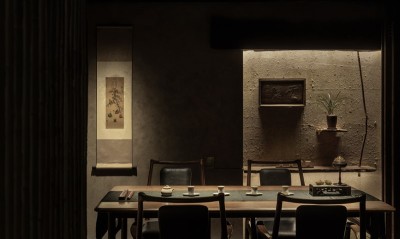
Wujie Xixi Teahouse sits within Hangzhou's Xixi National Wetland Park, a 11.5-square-kilometre urban-farming-cultural wetland known for winding waters, encircling hills, old villas and reed-fringed shores. The architects, Shen Mo and Tao Jianpu of Hangzhou Studio Moment, were asked to reimagine tea culture in a city that preserves tradition yet is increasingly driven by young consumers, and the client's brief was "a place that reads guests through scenery". The existing teahouse was dark, enclosed and dilapidated. Working with the traditional post-and-beam structure, the architects subtracted rather than added, inserting floor-to-ceiling glass that exposes the building's own skeleton; a large glass box at the threshold acts as an intangible boundary, linking landscape and interior while flooding the space with light. Entering, one moves along a gravel path to a miniature indoor landscape that mirrors the outside; sunlight moves across the walls, casting dappled tree shadows beside a quiet Buddha statue, slowing time like a mindful walk. The public reception is inspired by a white gift box: curved display cabinets outside hold tea for sale, while inside they store tea leaves, and the cabinet grid is subtly formed into the traditional character wu (boundless), reinforcing the brand. On the other side of the front hall, a small mountain-water scene with an old chair, a candle lamp and a suspended branch from a nearby tree projects a winding shadow onto the white wall, continuing Xixi's landscape indoors. To keep the facade free, white walls, glass and traditional timber columns are spaced apart in a dialogue of distance. Courtyard-side tea rooms were converted from former storage and expanded outward, each with a chair turned toward a specific view. A large meeting room lets conferences become tea-and-scene experiences, blurring boundaries around focused discussion. One tea room is wrapped in bamboo and combines contemporary details with seated tea drinking. The restaurant itself is a glass box set into the bamboo, embodying coexistence of tradition and modernity, building and nature.




 Editor's Pick
 Latest Design