Text description provided by the architects
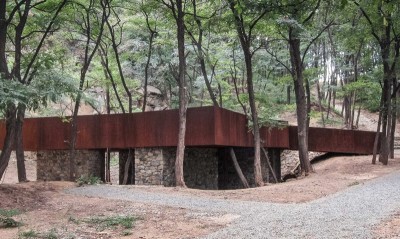
Mountains are elegant without being high, water clear without being deep. Yanxi Lake is like the last earthly paradise in Wuhan, with wooded islands and lake meeting sky. The tea house hides in a quiet forest by the lake, where visitors can walk through trees to gaze at the water or meditate through the seasons. Misi reshapes the collective memory of traditional architecture: a gabled house on a platform, floating like a boat in a sea of forest. A tall rectangular volume divides the tea house into a relatively independent entrance space and main room, serving as a service block whose top protrudes above the roof to house equipment and evoke a chimney. The exterior uses dark carbonized wood panels and louvers whose rough texture reveals time, blending naturally with the surroundings, while dark titanium-zinc roofing, black aluminum edge trim, and black steel frames provide refinement in a unified dark palette that lets the house quietly conceal itself in the forest. A hidden path leads through tall trees to the tea house. Inside, light takes over: the semi-open grey entrance softens the external world, and a short passage with a glimpse of floor-to-ceiling window leads to the main room. Light wood paneling brightens the main room, and continuous corner windows on both sides bring forest light and nature in, extending a panoramic ink painting where architecture, nature, and people merge. A strip skylight at the ridge is partly screened by a black metal panel, so daylight spills from both sides and guides inward reflection. Outside, a tree-filled platform continues the spatial order and dissolves the boundary between inside and out.




 Editor's Pick
 Latest Design
 Best Idea