Text description provided by the architects
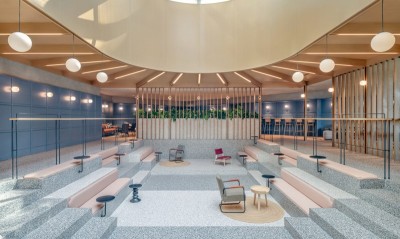
Longquan Mountain Mirror is an elevated observation platform and mixed-use hospitality building perched on the summit of Longquan Mountain in Chengdu, a site that has become the city's new high point as the metropolis expands outward. Longquan Mountain was once a rural backdrop, but it now anchors Chengdu's growth corridor; the surrounding hills and distant Xiling Snow Range lend the city a new vertical layering and climatic drama. BUZZ / Zhu Yuxiang Studio approaches the mountain as a flowing rather than fixed entity: in the Western tradition mountains are eternal and solid, but in the Eastern view they shift over geological time, like water or cloud. Accordingly, the building is conceived as fluid, dissolving and landscape-like. It does not stand upright on the ridge but reads as a fold of the ground itself, a horizontal outgrowth that echoes the Chengdu Plain. A series of continuous horizontal planes at different elevations defines the plan, enclosing courtyards that respond to the slope and frame views - some over the city, some back to the mountain. The rooftop becomes a winding, accessible viewing terrace, and beneath it a reflecting pool merges with a swimming pool, its water mirroring the sky until the boundary dissolves into the horizon. The roof is paved with irregular natural stone through which vegetation will gradually creep; the main facade uses grey GRC concrete panels, and horizontal louvres open the interior to the landscape. From the entrance, the infinity pool meets the foot of the snow-capped mountains in a vast panorama. The restaurant cantilevers beyond the hillside in stepped terraces, supported by three columns that line up with skylights in the pool above, casting rippling light onto the floor below; a separate tea room sits on one side, back-of-house functions on the other. At 4,200 square metres, the building contains a restaurant, bar, tea room, pool and viewing platform, completed in 2023 from a 2019 design. Its ambition is to be simultaneously a recognisable landmark and a landform fold, shifting between presence and disappearance as the visitor moves through the mountain.




 Editor's Pick
 Latest Design