Text description provided by the architects
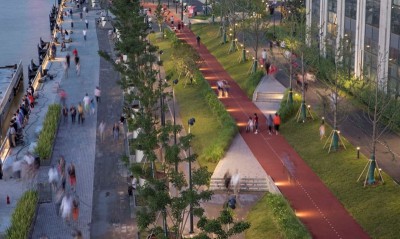
Island No. 9 at Sunac Xingyao Wuzhou in Tianjin is a landscape-upgrade project designed by AECOM for Tianjin Sunac. Historically, the lower Tianjin plain was a maze of low-lying ponds and shallows known as gu, where people fished, cut grass and boiled salt; as the city expanded, those waters vanished, and Island No. 9 recalls that lost landscape. The island was originally a borrow pit beside Tianjia Lake, low in the center and filling with a large pool in rainy season, its outline like a natural starfish floating at the northeast corner of the lake. The design reconnects Tianjin residents to their gu psychology while returning the wetland ecology the word implies, attempting through natural empowerment, greening of the barren island and revival of ideal life to create a healing interaction between people, nature and spirit. Following Ian McHarg's dictum that a good city must choose both city and nature, AECOM studied water level, soil, vegetation, light and climate ecologically. Because Tianjia Lake is a reservoir under strict ecological protection, no stormwater may be discharged into it, so multiple internal wetlands absorb site runoff; the original concrete embankments are replaced by soft grass slopes. The soil was heavily saline clay with salinity above eight per mille, almost barren; a fortunate terra-forming operation brought in a deep layer of sandy fill, allowing the team to plant a diverse mosaic of dense woods, open woods, meadows, mixed forests, wetlands and lawns. Salt-tolerant native trees such as scholar trees, golden rain trees, maples and ashes form the structural canopy, with cherries on higher ground and rushes, irises and loosestrife in wet hollows; ornamental grasses and self-sown meadows control cost while supporting wildlife. A spiritual inner bay opens toward the summer-solstice sunset, an eight-meter-high earth mound supports a cloud-like art ring as the island's lighthouse, and a pure-white lakeside promenade wraps the bay, wind, light and sound. The result is a multi-species, artistic, experiential human community that rebuilds relations between people and between people and nature.




 Editor's Pick
 Latest Design
 Best Idea