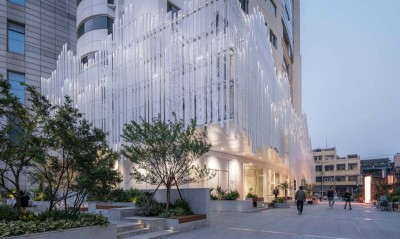
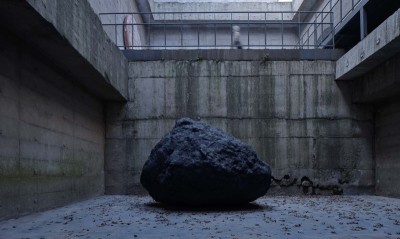
Text description provided by the architects
Kongbaigong Abbot's Building (Empty) is a three-storey structure at Tongbai Palace in Tiantai County, Zhejiang, designed by KiKi Architectural Design Office (with Akiko Akiyoshi, Chen Xin and Akihito Tochiuchi/TAKiBI) and photographed by Ruijing Photography. Tongbai is the ancestral temple of the Southern Line of Daoism; the original temple, founded by Sun Quan, was submerged when the Tongbai reservoir was built in the early years of the People's Republic, and the new temple has been reconstructed slightly to the northeast of the former site. In Daoism, the abbot (fangzhang) means the dwelling of an immortal, kept at a distance from the mortal world, so the abbot's building is placed at the top of the courtyard complex, the point visitors look up to and finally reach. Unlike the more solemn main hall, side halls and scripture pagoda, the abbot's building is for daily cultivation, and the design task was to introduce restrained, airy contemporary language without abandoning tradition. Taking Daoist emptiness as its lead, the building carries the aesthetic of pleasing the ear, eye, emotion, will and spirit, and the attitude of observing all things with calm. The structure combines concrete with China-fir columns, stone walls and glazed facades, graduating from heavy at the bottom to light at the top. Vertical columns rise almost to the sky, and four roof planes seem to float, expressing emptiness between earth and heaven. The roofs are simplified, stripped of traditional overhanging eaves and ornament, but finished in grey tiles consistent with the complex; tile ends are capped in steel plate and combined with curved fir ceilings to form a wedge-shaped eave that blocks harsh overhead light. Full-height glazing and narrow vertical windows connect seamlessly at the top. From the first floor, a circular courtyard reveals the two characters for abbot, embodying the ancient philosophy of round heaven and square earth and the unity of human and nature. Upstairs, a viewing platform faces the Tongbai reservoir with nearby an-sha and distant chao-sa hills arranged in Daoist geomantic order; its fir ceiling converges toward the centre from eight directions, lit by eight spotlights that echo the eight-direction cosmos. Water, planting and bells in the second-floor courtyard moderate temperature and light without mechanical air-conditioning. Stone and timber are sourced locally, carrying humanist and green-building values into the abstraction of emptiness.




 Editor's Pick
 Latest Design
 Best Idea