Text description provided by the architects
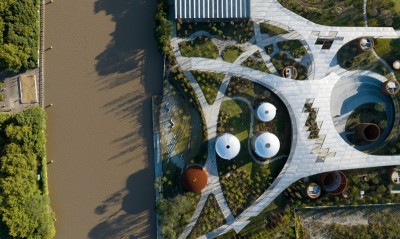
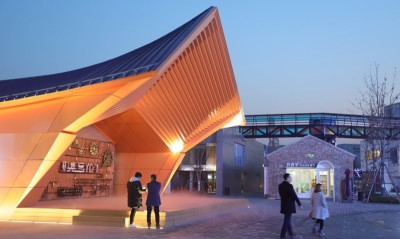
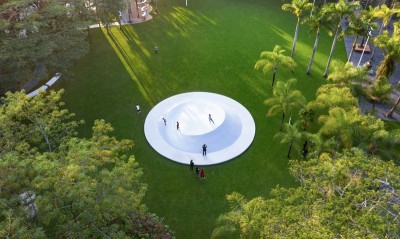
The Sanyu Shishi (Three Fish and Lion) Cultural Village in Chengdu's Eastern New Area is a rural-revitalisation project developed by the village in partnership with Chengdu Jianzhou New City Investment Group and designed by SECASE. The village, formerly Sanyu Village, had long suffered from poor roads, a single agricultural economy, an aging population, a lack of exercise facilities and rain-dependent farming. It also held under-appreciated heritage: a Han-dynasty stone carving of three fish sharing one head (symbolising prosperity, fertility and the Daoist idea that "the Dao gives birth to one, one to two, two to three, three to all things"), a Qing-dynasty stone lion said to be the largest ancient lion ever found in China and known as the "Asian Lion King", typical western-Sichuan dwellings, and proximity to Tianfu International Airport. The master plan, titled "Echoes of the Lion", operates on three registers: natural echo to repair mountain-water-field-village ecology, cultural echo to reactivate the fish-and-lion heritage, and airport echo to celebrate aviation. Four key scenes were delivered. The Taojia Compound, a 90-year-old rammed-earth farmhouse, was preserved and structurally reinforced using intangible-heritage techniques; a roughly 200-metre annular landscape pergola wraps a retained, purified pond and hosts intangible-heritage fairs, bamboo lantern shows, oil-paper umbrellas, tie-dye and covered-tea ceremonies. The Sanyu Water Gathering uses gravity-fed unpowered water channels that let children play in summer while the same water drains into an intelligent irrigation grid over the farmland below, linking play and productive ecology. The Sanyu-Lion Picking-Green sports field brings smart exercise to the village: interactive bikes that activate fountains by speed, a sensor-driven football penalty area, and a poetry-answer running game. The Big Fish Dream Bubble platform lets visitors jump on ground plates to release clouds of bubbles. The result has transformed a backward village into a model of rural revitalisation, selected for Chengdu's "Heart-Picked, Good-to-Visit" lifestyle list, while providing villagers with new income and year-round outdoor activity.




 Editor's Pick
 Latest Design
 Best Idea