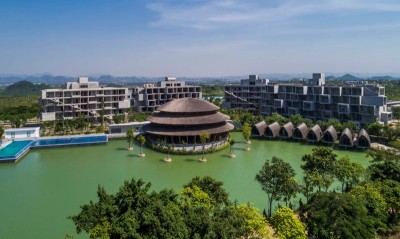
Text description provided by the architects
Yincheng Yuanxi Courtyard in Suzhou is a residential landscape that treats the classical Suzhou garden as living philosophy rather than formal mannerism. Located in Gusu District, one kilometer from the Lingering Garden, on a site of less than one hectare surrounded by ancient trees, the project houses a future community activity center that is also the entry to the housing estate. The design argues that Eastern philosophy should be sought in atmosphere rather than literal form, adapting modern spatial experience instead of copying traditional garden devices. Each courtyard is developed around the theme of nature, and within the small site architecture, interior and landscape are closely coordinated. The first water courtyard, Empty Forest, is entered after the gate: a still central pool reflects the building, three surrounding corridors, the woods behind the building, a rocky wall and the sky. The space is inward and blank yet seems to hold everything, separating the noise outside; a small cluster of trees breaks the water surface and carries the vitality of life, connecting with the natural stone wall on the west to link the upper and lower levels. Inside and outside, void and solid, hard and soft are allowed to interpenetrate in a way reminiscent of traditional garden architecture. Through a revolving wooden door lies the Green Abundance tree courtyard. Unlike the minimal water court, this space is grounded in soft planting, undulating terrain, rich groundcover and heavy stones, carrying a fresh, natural feeling. It is the everyday life room of the community, where activity should be diverse and optional; the designers emphasize atmospheric experience rather than picture-postcard viewpoints. Dappled tree shade and green abundance are intended as the beginning of residential life. Completed in 2019, the project is positioned as a contemporary reading of Jiangnan garden poetry, in which the pursuit of nature is not only a pleasure of life but a value transmitted through the spaces people dwell in.




 Editor's Pick