Text description provided by the architects
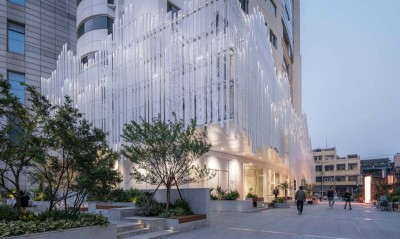
Changshu has long been a centre of light textile industry in the Yangtze River Delta, and its factory buildings represent an important urban typology. The Changshu Embroidery Garment Factory was founded in 1979 and moved in 1989 to 77 Haiyu South Road, where it enjoyed decades of prosperity in the city centre. As production gave way to consumption, the complex shifted from manufacturing to leasing, and overuse left the buildings dilapidated and their infrastructure outdated, turning the once-vibrant campus into a negative space in the busy downtown. In 2019 the Changshu Jiangnan Group commissioned a renewal designed by Mixiong Architecture, led by Lu Zhigang, to reawaken its value. The site comprises four multi-storey buildings on 10,000 square metres with a total floor area of 9,726 square metres. After careful survey, the team chose to preserve history and existing conditions, demolishing and rebuilding only one dangerously unstable brick storage structure while locally reinforcing the remaining workshops, offices and dining hall. The central challenge was how to implant new programmes without erasing urban memory, producing a sustainable organic transformation that juxtaposes old and new in time rather than covering one with the other. To bridge the strongly differentiated buildings, the design introduces a single wandering element: a cloud corridor. Cloud is the most abstract, most expressive motif in Chinese landscape painting, dividing peaks, concealing pavilions and provoking the viewer's imagination; it becomes the project's formal device. A floating, sinuous cloud gallery weaves between the rigid volumes, filling gaps and lifting pedestrians off the ground into a promenade through time and space. The new element both retains the place's memory and disrupts its old order, allowing the buildings to read as the most interesting faces of the site rather than isolated blocks. Renovated in 2021, the project is positioned as an innovative approach to adaptive reuse, following earlier phases that moved from wholesale demolition-and-rebuild to faithful preservation. Its true value lies in use: the rich, individual traces brought by successive occupants are what make architecture serve people and record the era. The retained buildings and the new cloud corridor remain incomplete until people move through them, laughter echoing across the site, completing the picture. The project echoes Bian Zhilin's famous lines about watching scenery from a bridge while someone watches you from a tower.




 Editor's Pick
 Latest Design
 Best Idea