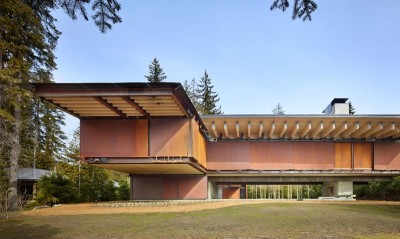
Text description provided by the architects
Shiyuan, or Persimmon Garden, is a homestay renovation in Wangjiatuan Village, Zhangcun Town, Huancui District, Weihai, Shandong, commissioned by the Zhangcun Town government and led by architect He Wei with a team including Chen Long, Zhang Jiaojie, Sang Wanchen, Li Qiang and Wu Lijun. The village has a century-old fabric of well-preserved Jiaodong dwellings, but agricultural decline and outward migration have left many houses idle, so the project asks how rural tourism can raise living standards while preserving character. The site contains two traditional courtyard houses set back from the road behind more than twenty metres of overgrown orchard, with a path leading to a wooded back hill thick with persimmon and catalpa trees; the original houses are single-story Jiaodong compounds with grey tile roofs and rough stone walls, a craftsmanship the designers sought to foreground. The ambition was a northern wild garden—rustic yet curated, with a literati sensibility—where existing trees, hillside and stone become the principal set-pieces. Because of land-title constraints, new service buildings originally planned around the trees were simplified into two contemporary pavilions placed at either end of a shallow reflecting pool, its 30-centimetre depth edged in metal and drained in winter to become a sand play area; the pool was cut around two existing trees, leaving them to rise through circular openings. The pavilions borrow traditional mortared-stone bases and timber grilles but use single-pitched roofs for a contemporary regional reading, while boundary walls combine laid stone and timber palisades to layer craft histories. Two retained stone houses were reorganised into four family suites, each with a king bed and an extra bed for parent-child stays; the architects did not fossilise old stoves or kang beds but enlarged living rooms, added proper bathrooms and stitched rooms together. Interiors use white textured render, grey terrazzo and oak furniture as a quiet counterpoint to the rough exterior, while persimmon-red accents and a collection of salvaged local furniture—old tables, cabinets and a sewing machine—tie the project to place. As a government-led pilot, Shiyuan reframed rural development from what the village wants to what visitors need, and has since attracted new residents renovating derelict farmhouses, gradually reviving the village.




 Editor's Pick
 Latest Design