Text description provided by the architects
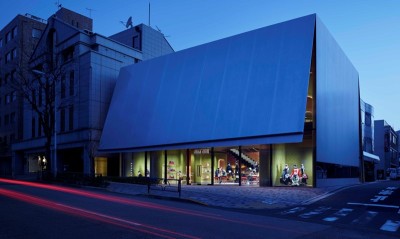
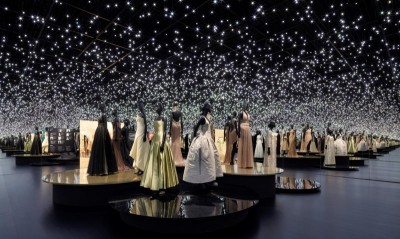
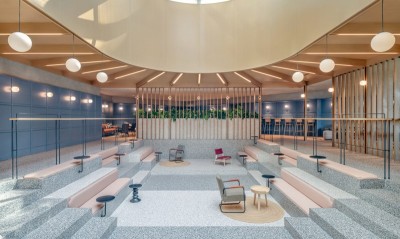
Yuanli ReIN in Nanjing is an 800-square-meter interior designed by Erwo Space Design Studio, directed by Ding Pengwen, combining a beauty salon and a photography space. Isamu Noguchi wrote that trees and grasses share a natural instinct, but nature has many dimensions; concrete can be natural, interstellar space can be natural, and human nature is natural, so that in the city one must have a new nature, perhaps must create that nature. The space is conceived as a smooth realm of time and space that estranges everyday behavior and perception through blankness, rupture, floating, extraction, cutting, juxtaposition, and the expansion of existing context, producing a de-materialized landscape. Estrangement is not the goal but a means to release perceptual energy in a pure vacuum, touching a non-material experience absolutely. The beauty salon is placed in the quiet interior, concerned with individual beauty in everyday reality, while the photography space is shared in the open public zone, concerned with how beauty is expressed through the lens. The estrangement from reality begins at the entrance and facade: the entrance tilts inward, peeling away the conventional building frame so that the outer frame reads like a spatial coordinate system, and the angle between facade and axis hints at a deviation between the real and the surreal. A highly abstract exterior, unmarked by theme and de-materialized, enriches the hard boundary. The form's fracture and distance give the inserted space, lodged in the ground floor of a commercial building, a certain phenomenal permanence, reinforced when a circular entry cut from seamless stainless steel offers a passage into the material world. Yet inside, the space converses with surrounding urban life through perception-centered organization, challenging inherited ideas of material space while remaining adaptable to future change: extracting from the everyday is precisely the way back to the everyday. The interior is a seven-meter-high void; rather than splitting it into economical floors, the massing is pulled upward, leaving a gap at the top that breaks the closed form, while walls with absolute volume and sculptural presence form a continuous landscape of geometry between continuity and rupture. Thick, solid walls create rich, abstract geometric relationships through cut sections, sliced corners, dynamic triangular volumes, walls that hover above the floor, and circular and square holes evenly distributed. White gives these thick walls a floating lightness, making visual volume ambiguous and perceptually tense. Space presents itself through events, but the public zone does not prescribe a specific event; it is itself the unfolding of an event, open to time. For avant-garde photographers, not forcing a narrative leaves room for them to create their own instantaneous events through the viewfinder. The system is dynamic and centerless, with no prescribed progression, allowing wandering, performance, casual sitting, and conversation with another self. An array of diagonal triangular volumes, among the few elements touching the ceiling, has a ritual, monument-like presence, helping photographers define key spatial moments. Light fills the space like fog, so it is remembered not by physical scale but by the volume of light; mirrored surfaces and uniform diffuse reflection overlap real and virtual images, dissolving accustomed reference points. A red flickering object floats in a blue darkness like a buried space capsule, and horizontal geometric blocks and primitive metal installations stir inner perception, suggesting art returning to its most raw state after repeated sublimation. The ground uses crushed stone, outdoor stepping stones extending as paths, soft carpets simulating lawn, and green moss that reads as rolling hills at a distance. These materials, by their natural or artificial organic qualities, create a conceptual nature that broadens the understanding of nature. As Noguchi said, concrete can be natural, interstellar space can be natural, and in that context, the geometric landscape within this indoor Yuanli is a genuine landscape.




 Editor's Pick
 Latest Design