Text description provided by the architects
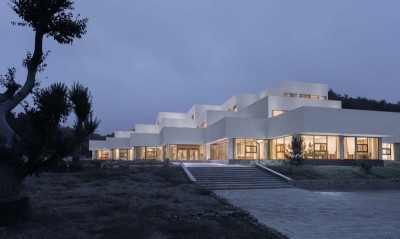
Site and background: Somewhere in the Tengger Desert The project is located in the Shapotou Touristic District in Zhongwei City, Ningxia Hui Autonomous Region (NHAR), China, which is a sand sea about 2km away from the desert reserve. In recent years, desert tourism in Zhongwei is in the ascendant, and the Desert Galaxy Camp is a newly developed camp. As the main building of the site, the project not only provides supporting services for the camp, such as catering and comprehensive reception, but also serves as the symbol of the whole camp. There is no cultural landscape or historical context around the site. Here, the desert is the most intuitive and significant element, where the rolling sand dunes stretch into the distance. When the weather is good, the mountains in the north are clear to see. Observed carefully, the desert is not all of the same pattern, but with the rhythmic sand ripples formed by wind blow, sand masses formed for unknown reasons, tenacious desert plants with small light yellow flowers on their dry branches, traces of desert beetles climbing over sand dunes, and so on. These comparisons between big and small, same and different, life and death give architects insight. Architectural concept: a treasure box half buried under yellow sand At the beginning of the design work, through access to information, the architect found that Zhongwei had been an important post in the northwest frontier fortress since it was incorporated into the territory of China in the Qin Dynasty. Although Zhongwei was not directly on the ancient Silk Road and was not as important as the City of Yinchuan, it also left many deeds because of its unique geographical location and natural environment - the Yellow River and the desert. For example, Gengiz Khan, the first emperor of the Yuan Dynasty, passed through Shatuo (now Shapotou) to Jiudu Ferry of the Yellow River and captured Yingli County (formerly Zhongwei County). The famous Tang Dynasty poet Wang Wei's most well-known verses, "The lonely smoke in the desert rises straight, and the setting sun over the Yellow River falls round. ", is also said to describe the scenery here. The long history can't help but make people imagine how many stories are still buried under the desert, waiting for people to discover. For a building in the desert, the architect hopes that it conforms to the temperament of the desert accordingly - mysterious, impermanent, calm and warm, just like so many stories about the desert. The architect chooses straight lines and geometric forms as the basic elements of the building, simulating a huge rectangular solid half buried in the yellow sand, and endows it with a narrative metaphor - the lost treasure box. A story carrier that is submerged in the desert and waiting to be found. Layout and space: the exterior and interior separated, and the odd and right corresponding Due to the limitation of land use, the building is arranged along the northwest-southeast direction. The general plane is an isosceles triangle with the bottom facing the Tengger Desert in the northwest. The building is shaped like an inclined box half buried in the desert. Its skin is covered by perforated rusted steel plate. Opened in its northwest side, transparent materials are used to form the communication of indoor and outdoor lines of sight. The functional space in the building is the main body of the treasure box.




 Editor's Pick
 Latest Design