Text description provided by the architects
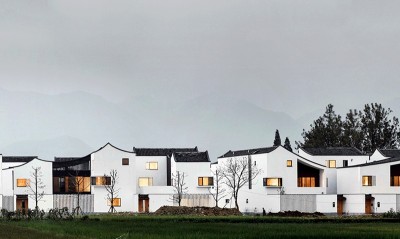
Located on the northeast of Wuyuan County, Jiangxi Province, Huangling is an ancient village in Huizhou, with an altitude of 500m and a history of nearly 600 years. It is known as “the most beautiful village in China” for its charming ecological environment and classic Hui-style building clusters, and also the birthplace of the time-honored and well-known “Shaiqiu” culture (grains dried by exposure to the sun). But in the context of faster urbanization and fewer villagers in rural areas, many ancient buildings of the village tended to perish, and uninhabited residences faced collapse or reconstruction. In June 2017, Wuyuan County suffered the worst flood in 100 years, and Huangling Village was not spared. Many landslides destroyed the vegetation in the village and brought irreparable damage to the environment. In response, the project is intended to restore the vegetation and environment ruined by floods, whilst also rejuvenating and improving the fabrics of the old village from an overall perspective. It is a complicated rural project that takes into account both protective repair and creative renewal, including a series of architecture and landscape optimization measures like flood prevention and water diversion engineering, residential ancillary facilities, old residences restoration, and new houses construction. Geological difficulties posed great difficulties for construction and transportation, because loess and broken stones clog the valley. The water conservancy program took two years, 80% of which was finished over the shoulders or by hands, forming a complete water system to get over water shortage. In addition, the project scientifically transforms and organizes the roads in the village, restores old-style architecture, and elaborately creates ground art landscapes, making the whole village seem to grow organically in nature. Balancing “original” protection and “driving” development is the key to the protection of the ancient architecture and village. Some houses in the Huangling Village collapsed and decayed over the years, and caused many vacant foundations, which broke the integrity of the village. Uninhabited old residences in disrepair approached collapse or reconstruction, and the unique ancient architectural resources were in danger of quick disappearance. Based on the positioning of protecting good ancient dwellings in Wuyuan County and developing local rural remains, the project innovatively creates the relocation and conversion method for ancient architecture, and adopts technology to relocate, arrange and restore local typical Hui-style ancient buildings on the verge of decay and collapse. Through tireless efforts, traditional residential and public buildings constitute an integrated Huizhou village architecture system, and meanwhile ancient constructions are well repaired and managed and create value, thereby forming a virtuous circle of protection and utilization. The differentiated relocation mode has become a model for the protection of ancient buildings in China. Embraced by mountains and water, Huangling is a typical U-shaped ancient village, with dwellings arranged around the mouth of water in fan shape. The water diversion program is situated on the forest at the entrance of village and the mouth of water. Water flows gather into a reservoir. Water diversion pipe with a diameter of 160mm buried in the mountain leads to the general water supply pool at the head of the village, which avoids excavating mountain and protects the original ecological environment. The position of stacked-stone water and waterfall is reserved according to the height difference and terrain. 15mm-thick reinforced concrete layer is poured on the rubble concrete foundation, with waterproof cloth covering the surface, with a view to ensuring no leakage after completion. Houses are organized in a staggered way also based on the height difference and topography. Hole and pile are manually dug, the foundation is made of cement, various pipelines are embedded, and drainage and sewage outlets are reserved in advance. The design and construction process follows the sustainable principle, maximizes the environmental friendliness and resource circulation, and minimizes the damage to the original village appearance as well as the traces of repair. For example, the spring water on the mountain is introduced into the village by making use of the natural height difference caused by terrain and the direction of the original gully, thus producing a complete water system. The project employs the original materials on the site such as red soil and rubble and traditional construction techniques to create a new, diversified and ecological architectural appearance. The ground is paved by old-style stone slabs and inlaid with pebbles, which is quaint and dynamic and harmonizes with the village atmosphere. Architectural, landscape and spatial elements are integrated and create a rhythmic, complementary and comfortable environment. The rural reconstruction project aims to explore and improve the relationship between people and time and space. Huangling, a village which is intersected with spectacular mountain and valley and has tortuous creeks, enjoys the most characteristic folk landscape “Shaiqiu”. Since ancient times, local villagers have peacefully “communicated” with the rugged terrain, and exposed their harvested crops on bamboo sieves to the sun in autumn, which is space-efficient and also convenient for collection. Centering on this theme, the project amplifies this cultural symbol by adopting artistic vision and techniques. Besides, on the premise of preserving and maintaining the traditional spatial fabrics and architectural style, it digs into the connotation of this ancient village and infuses culture into it. The earthen brick exterior walls of Hui-style residences featuring the trace of time and the constantly updated objects dried by exposure to the sun reflect the local daily life in which human live in harmony with nature, and create a spiritual habitat with unique expressions, where agricultural customs are activated and street and alley culture is restored. The mixed frame of ancient dwellings, the staggered terraced fields and the picturesque natural sceneries are integrated into ground art landscapes whose colors strongly contrast with shapes. The large-scale terraced fields around used to be abandoned, but now they are planted with rapeseed flowers and rice that are adapted to the local Jiangnan-featured environment. With layered ecological landscapes, the terraced fields appear like an “overturned paint bucket”. The original vegetable fields and orchards in the village also resume being planted with fruits and vegetables. A variety of colorful trees are grown in and around the village, forming the beautiful flower sea that varies with seasons. com





 Editor's Pick
 Latest Design