Text description provided by the architects
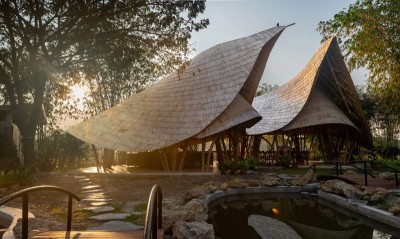
The Fengqi Pavilion, or Phoenix-Perching Pavilion, stands in the Youtian Ecological Pastoral in Jiangxia District, Wuhan. The site itself was a large waste dump three years ago and has been ecologically restored into an outdoor education base for primary and middle-school students. The pavilion is built entirely on green ecological principles, fusing traditional Chinese culture with modern craft. Designed by Jiangzuo Studio and built by the design team together with the client Xiong Linhui, the pavilion uses bamboo, a locally abundant, economical, and renewable material. The beauty of bamboo structure lies in form, construction, and meaning held together; the project pushes bamboo-building craft to discover new possibilities, pursuing poetic dwelling between wind and sound, movement and stillness, being and non-being, void and solid. The open, elegant form resembles a phoenix spreading its wings, invoking the Chu-region totem of the phoenix and giving the pavilion its name. Modern structural ideas and fabrication techniques are fused with the classical image, balancing contemporary feel with classical resonance. Hunan moso bamboo is curved using heat treatment, and steel connectors at anchor points ensure durability and allow individual members to be replaced. An arch structure achieves long spans with minimal material, and the curved, lifted bamboo members break the stereotype of straight bamboo construction, fusing structural technology with sculptural beauty. A woven bamboo-mat roof adapts to the hot local climate and creates distinctive light patterns; mats are deliberately left open to let through threads of light and slices of breeze, so the pavilion remains a place to watch clouds rise. The mat strength also leaves the option of adding lightweight tiles for rain protection in future. At end of life, bamboo biodegrades and steel members are recycled, completing the sustainability loop. The pavilion is intended as an outdoor room where children can meet nature freely and as an on-site classroom for sustainability.




 Editor's Pick
 Latest Design