Text description provided by the architects
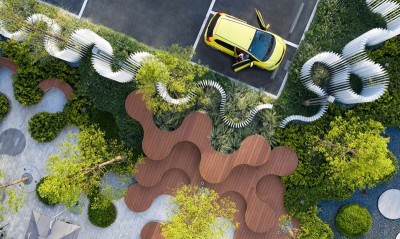
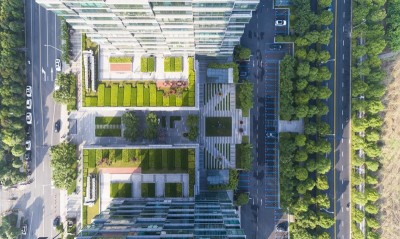
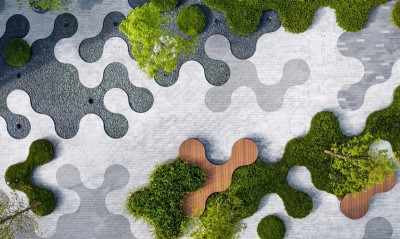
Coordinated Design and Operation Model Under New Participatory Design Strategy – Wuhan Jiangchen Paradise Walk Rooftop Landscape Introduction The urban landscape is a reflection of social ideology and behaviors. People's values, behavior patterns and social relationships are all straight forwardly stated in the urban landscape. If designers can create the environment, and at the same time, the environment creates the consciousness of people, then the important social responsibility of urban designers is to promote strong participation of users through the design of public places. We believe that the essence of public space is that people and others are in an interdependent and mutually-constructed relationship, and acting together or living together to form collective existence. Reflecting upon open space design of the new era today, in order to realize human-centered design ideology, we must start from today’s background understanding that includes self-identity value, photo-sharing culture, and social networking, based on the premise of precise users. Site Background The project’s retail rooftop is located on Wuchang Qingnian Road in Wuhan. The client hopes to transform the roof into a regional landmark that attracts young people to visit here, and FLO took this opportunity to participate in the design process from ideation to site implementation. Due to lack of retail interface adjacent to our rooftop and lack of accessibility of the roof from lower levels, the primary challenge is how to create a highly functional and attractive space to attract visitors. In addition, how to integrate user needs with the basic conditions of the site with a unified identity is also one of the other main challenges in this project. Coordination with MEP to release bigger design space for landscape Added vertical and horizontal circulation to enhance accessibility and spatial interaction Identification of planting zones in advance to save unnecessary structural cost New ParticipatoryDesignThinking Precise Target User and Targeted Place-Making Participatory landscape, as the name suggests, should be focused on users emphasizing diversity, interaction, and a sense of belonging. Traditional participatory thinking tend to cater for preferences of all age groups and interest groups to satisfy broad user groups. Consequently, designers tend to provide corresponding functions and facilities without in-depth study of human behaviors. This traditional design approach brings several problems. First: Weak Spatial Correlation. Designers intentionally allocate diverse functions to satisfy all kinds of potential users, and at the same time, the relationship between function areas is weak, which leads to spatial fragmentation. Second: Weak Identity Recognition. Due to lack of specificity of activity scenes, each scene is less strong in identity and therefore less likely to attract any targeted user. Third: Weak Culture. Sense of collective identity and belonging creates social cohesiveness of space. However, traditional participatory approach makes it difficult for people to form collective consciousness to generate any certain kind of culture. 1. From Mass User Participation Model to Precise User Participation Model 2. From Compartmentalized Interaction to Participatory Interaction The purpose of the New Participatory Design Thinking is to solve those problems. Itsmain strategy is to identify precise targeted user and generate peripheral impacts of diversified public behaviors. On this basis, the design aims to maximize tailored place-making to enhance social binding andgenerate a strong culture. The user-centered approach can potentially attract wider range of interest groups and trigger diverse spatial and behavioral relationships. New Way of Life CITY-POPHedonism Young people nowadays have abundant material wealth to pursue emotional freedom and other care-free lifestyles. They are relieved from material anxiety and spiritually free to explore gratifications that are beyond realism. This is the portrait of China’s contemporary youngsters. During the design process, we realized City-Pop culture that originated from Japan in the 1970s is similar with today’s era in China. During the 1970s, Japan's economy developed rapidly, young people actively embraced hedonism which formed City-Pop living concept. City-Pop further develops into a unique visual trend in graphic designs. Beaches, ocean waves, blue sky and sunset are all classic visual elements of City-Pop. “Dark days are over, and the illusion of a better living is right in front of us ". We feel the ideology behind City-Pop is not only extremely consistent with the spirit of the place, but also perfectly in line with our targeted user and the site conditions. Design Strategy 1. Targeted Function: Streetball Landmark The design starts from identification of one strong function. In order to achieve the goal of attracting young people, we identified a portrait of trendy youngsters that love sports. We proposed basketball as the primary attraction of the rooftop because basketball is the most popular sport in China. As a team sport, it is very engaging with the audience and especially suited to become the main feature attractor. Also, due to the shortage of urban space and limited number of basketball courts, providing a basketball court here has a strong functional purpose. At the core, we hope to design a court that caters for "competitive basketball lovers", and putting forward the concept of "sports + entertainment + photo-taking" that centers around it. Firstly, we want to design a basketball arena that attracts real ballers. Secondly, around the theme of basketball, we want to create entertainment spaces that attracts viewers and related interest groups. And lastly, we want to create a series of photo-taking spots to attract other curiosity hunters to visit the rooftop. 2. Targeted Operation: Operator and IP Implementation of "Venice Beach Basketball Court" After confirming with the client that our goal is to create a streetball landmark, through multi-disciplinary interaction and discussion, the client also successfully brought in a professional basketball court operator, which not only solved the problems of venue maintenance and management, but also created rental income for the mall itself. The IP theme of the classic “Venice Beach Basketball Court” on the west coast of the United States is also brought in to our project. Venice Beach Basketball Court is the shrine of street basketball in the United States. The most common scenes here are blue sky, white clouds, palm trees, beach sands, parasol and all kinds of streetball legends. Here, you can not only experience the highest level of professional competition, but also enjoy the leisure of playing basketball in such beautiful setting. The basketball culture here is inseparable from its scene. The design team hopes to refine and reinterpret the elements of this IP theme into the design and create a unique selling-point for the client. 3. Targeted Place-making: Sunshine Hedonism For the site itself, if we want to maximize attraction and create successful place-making, we need a targeted scene that perfectly matches our targeted user. Therefore, we have used City-Pop as the main place-making imagery to implement its characteristics into the design of this rooftop. Design Interpretation In the visual expression City-Pop, the most obvious feature is its high purity of colors mainly constructed of sky blue, sea blue, cloud white and wave white as the main use of colors. In the landscape design, we have also inherited the characteristics of City-Pop in the use of those colors. We make full use of classic elements from City-Pop such as waves, palm trees and sunset that frequently appear in such imageries. The design incorporated the sunset element at the pilgrimage route into the basketball court, and the design of shading structure and use of palm trees along two sides of the court is also representative of City-Pop. The running track on the roof is also abstracted as a long wave that connects different spaces to form an interactive cheering spot and recreational route. 1. Floating Beach Basketball Court The basketball court incorporates sky blue and ocean blue and the language of waves to create an immersive vibe like playing on the beach. The open space on the rooftop provides a natural condition of sunlight that further enhances such atmosphere. 2. Palm Trees Against the Blue Sky Palm tree plantings that are approximately 9. 5m in height are planted around the court to create spatial enclosure against the blue sky in the backdrop. The overall image of the space is rendered somewhat surreal just like City-Pop living concept, and provide a haven for people to escape from their ordinary city life. 3. Floating Wave Running Track In response to the spirit of hedonism, the wavy running track forms two turbulent wave photo-spot at the end points. At these scenes, astronaut surfer sculptures are integrated. On the basis of our surreal setting, the IP sculptures and the environment complement one another in the spirit of City-Pop. 4. Sunset On The Horizon The design incorporated the sunset element at the pilgrimage route into the basketball court. The sunset element in white perforated metal has yellowish illuminance during the night, creating another feature spot for photo-taking. The wavy design language and the use of fonts are also consistent with the City-Pop image we want to create at the horizon. Conclusion In the context of China’s new economy, we believe the design of a highly participatory public space should be user-centered and actively engaged with commercial operators to create successful place-making for the greater good. On that basis, targeted function, targeted operation and targeted place-making can potentially be the ultimate solution in building a better future for our future public spaces in cities. In this project, the new participatory design approach has successfully created strong engagement, identity culture and a new landmark in Wuhan suited to our contemporary lifestyle. Wuhan Jiangchen Paradise Walk Rooftop Landscape 518 Jianghan District, Qingnian Road, Wuhan City, Hubei Province




 Editor's Pick
 Latest Design