Text description provided by the architects
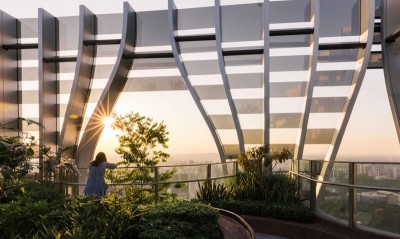
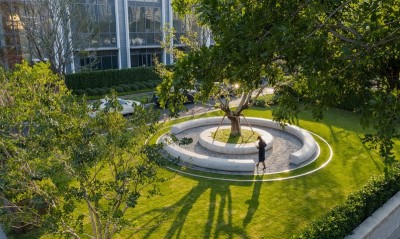
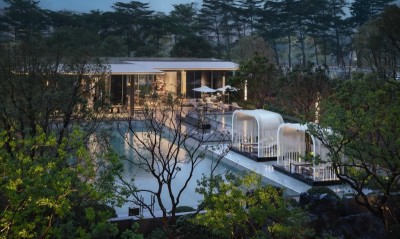
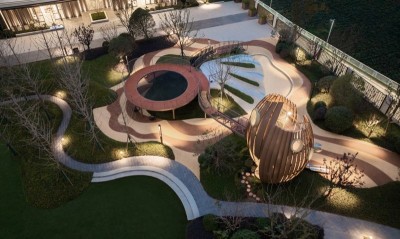
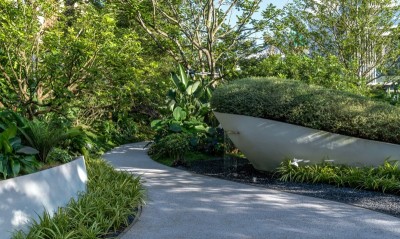
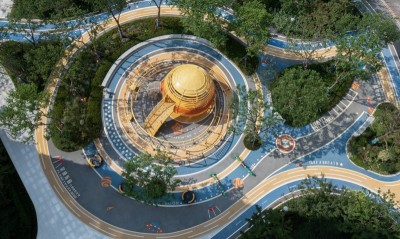
When Dahua meets Kunming, landscape operates as a time machine. Taking the mythic Peng bird as its inspiration, Guangmu Landscape, under design director Gao Fang, gives the place vitality and contemporary presence, looking beyond the memory of an old factory to a boundless future. West Kunming, along the ancient Tea-Horse Road, is being reborn through urban renewal: with the new high-speed West Station and a transit-oriented new town, the 3,200-mu TOD master plan around the station will deliver commerce, offices, a hypermarket, the Majie cultural shopping street and branded schools. The Dahua Jinxiu Shanhai site covers 2,500 mu, leaning against Mian Mountain and overlooking Dianchi Lake, only 800 meters from the high-speed station and spanning three metro stations; the first-phase display area sits on Plot 12 beside Exit C of Dayu Road Station on Metro Line 3. Protecting industrial heritage, the design links ecological resources and urban axes to weave a linear city park that joins public and private space, inserting commerce, entertainment and leisure to form a futuristic urban garden community. A municipal street is absorbed into the design: a camphor grove beyond the station leads naturally to the display area, and the city living room, private garden and forest café pull passersby in. The display area uses the Dahua Peng IP as a spatial device, stringing the journey of the Kun fish transforming into the Peng bird through nine flowing states. The gate pairs anodized aluminum panels with Jazz-white marble-look tiles in layered setbacks, and an 15-meter-thin, super-wide multi-curved canopy rises like a Peng wing, solving grade change and lengthening the route; 76 columns rise like waves breaking, star lamps trembling in the water like a galaxy. The inner court stages the moment of the Peng riding the wind, with water-wave and hill-textured enclosures, central water and grass slopes, bamboo and local Yunnan hackberry planting. Four hundred pale champagne-gold wind chimes hang from the corridor, and rolling terrain acts as blank space on the plan. A time-tree-house mini playground invites children to discover the world through play, interaction and digital technology.




 Editor's Pick