Text description provided by the architects
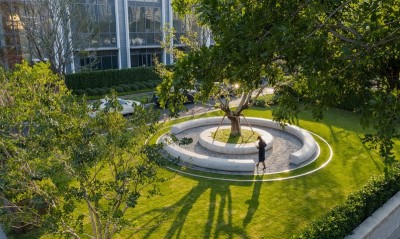
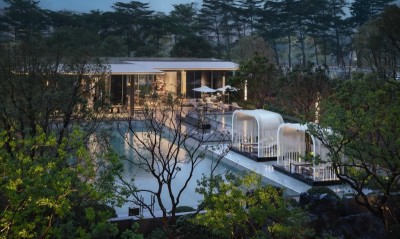
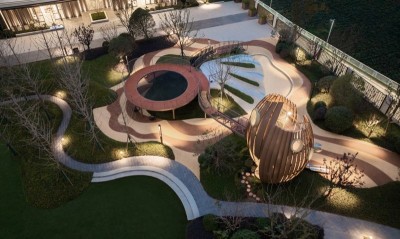
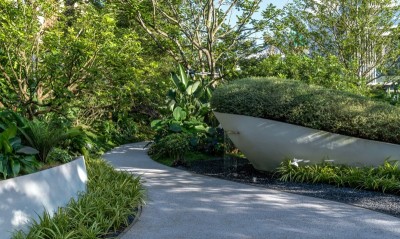
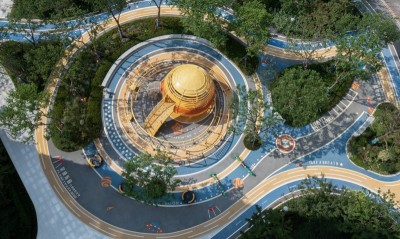
Zhongwei Blue Bay lies in Nansha, Guangzhou, at the meeting of river and sea, backed by the Huangshanlu Forest Park, near the Nansha Tianhou Palace and the broad Lion Sea. Developed by Guangdong Zhonglvyuan Land, designed by Shenzhen XXSC Landscape and built by Sichuan Hanbang Landscape, the 16,460-square-metre project was designed from 2020 to 2021. Nansha is the frontier free-trade port of the Greater Bay Area, and the design argues that open, inclusive Guangzhou is waiting for an art garden with attitude. The design uses fluid curves like flowing water, imagining a green forest island floating in winding streams or a fish swimming in a sea of trees. White and green are the governing palette: white textured walls along the municipal road, shaded by elegant trees, form a fresh, continuous street presence, while the gate and feature wall read as one. Two podocarpus pines stand at the entrance, and a hand-brushed, water-feature wall transforms the mood from street noise to stillness. Wave-like petal sculptures float on a dark mirror pool like scattered pearls. Because the show flat sits between the entrance and sales centre, the designers borrow the classical Chinese garden technique of suppress-then-reveal, using feature walls to separate road, garden and showroom into a shaded, meandering gallery; curving pale walls, bright planting and sky visible through the trees create a quiet interlude. Beyond the gallery, space opens onto a marketing lawn where water cascades and fish sculptures swim upstream. The show-flat garden takes a gentler tone, with undulating small terrain, lush borders and freely growing Chinese tallow trees, while furniture and planters avoid direct sightlines between balconies. The Tree of Life main sculpture wraps a school of fish into a DNA helix, expressing coexistence with nature; the spirit monument uses new eco-friendly materials in dialogue with the city.




 Editor's Pick
 Latest Design