Text description provided by the architects
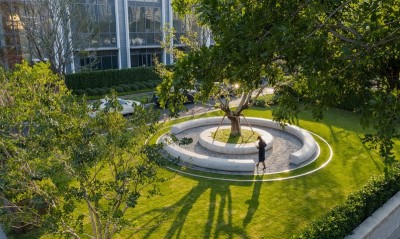
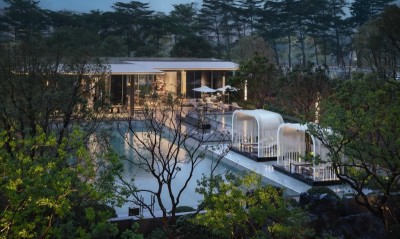
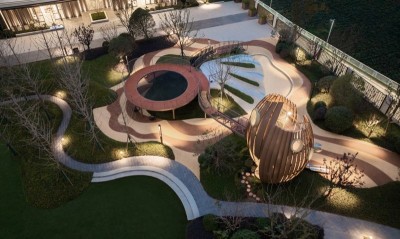
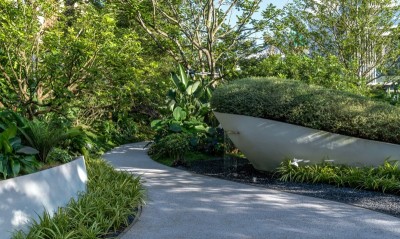
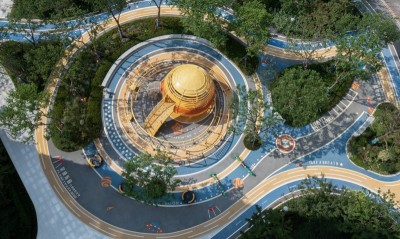
Rong'an Kowloon No.1 on the Nine Dragon Peninsula in Chongqing is a 4,000-square-metre residential landscape that draws on the rough, brotherhood-inflected character of the mountain city, where banyan trees, the historic traffic teahouse, the graffiti street and the Sichuan Fine Arts Institute have long taken root. The client asked the designers, Chongqing Tixu Construction and Zhejiang Dahua Curtain Wall's Chongqing branch, to root the project in place while delivering a quality contemporary life. The project entry is deliberately retained as a civic gesture: an unassuming leisure pocket for old-town residents in summer. A deconstructed grey-brick wall, laid in ordered courses, opens like windows of life onto the street, linking the interior with the neighbourhood. By day, passers-by rest here and watch light and time move across the bricks; by night, silhouettes behind the wall perform everyday scenes. An art corridor extends the entry, using openwork feature walls to pull natural light into a light tunnel whose lines change through the day, inviting people to pause. The central courtyard is a deconstruction of old Chongqing: the historical record speaks of a banyan tree at the foot of Tu Mountain with a banyan crossing beneath it, and locals once settled under such trees, fanning themselves in childhood memory. The twisted banyan root system is taken as a design prototype, weaving river, rock, root and tree together; seen from above, water-root-rock-tree flatten into a plane, and the banyan's reflection scatters among the roots. A street-side vitrine opposite the banyan lets the enclosed site breathe, and through it old and new, future and present, converse in one moment. The outdoor leisure zone reinterprets the traffic teahouse in a quieter, more introspective key: grey bricks and green tiles become a sloping water wall; the projection of old window lattices becomes a blue jacarandha-patterned pool; long teahouse benches and square tables become simple sofas. A golden pitched roof opposite the water wall represents sunlight through the teahouse skylight, interweaving with tree shadows.




 Editor's Pick