Text description provided by the architects
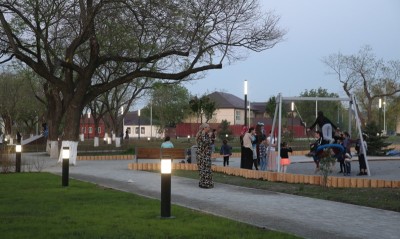
At the Yixingbu heritage site in Tianjin's Beichen District—a settlement founded in the Ming dynasty by migrants from Jiangsu's Yixing who stopped on the Grand Canal northward route and recreated a village pattern—BAM has rebuilt the historical grid as China's first sports park of its kind. Bright, fast and strong, the park combines a colorful maze, sports zones, a beer garden, a water-play hill and a vivid yellow geothermal chimney, training both body and mind. Four overlapping quadrants organize the program around two axes: a southeast-northwest central spine linking surrounding residential communities to the metro, and a large central plaza for daily leisure and major festivals. The plaza is actually a geothermal well, and BAM refused to hide the infrastructure; instead, a tall chimney vents heat and becomes the square's central landmark. The northern quadrant houses the sports garden for residential interaction, the eastern quadrant concentrates cafés and restaurants connecting the basement commercial street to the metro, and the southern quadrant gathers richly varied play landscapes. Four interlinked mazes—water, hedge, earth and wood—offer families different ways to lose themselves, the hedges evoking the winding lanes of an old town and the mazes as a metaphor for learning to find one's own path. Because the site is small, BAM treats it as a high-density park whose most important ecological function is to raise users' environmental awareness. The interactive water-play hill is a working hydrological model that condenses the Yangtze River Delta landscape, the Three Gorges reservoir and the ancient Dujiangyan irrigation system: children operate outflows on miniature hills to simulate mountain rainfall, adjust dams along the river to redirect flow, and watch uncontrolled water spill into other channels and finally to the sea. By turning abstract knowledge of river management into three-dimensional play, the project embodies BAM's belief that nature is a concept: the park is not wilderness but the ideal form of nature, where infrastructure's inhuman scale gives way to a measured, scaled public realm.




 Editor's Pick