Text description provided by the architects
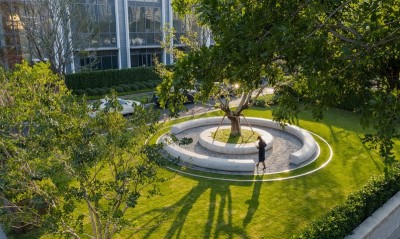
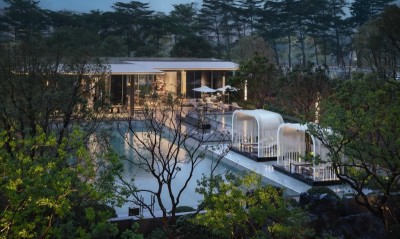
China Railway Baijinggu Nan Yuan in Guiyang is defined by two ancient trees whose overlapping canopies read as an expressive ink painting against a native background forest. The site slopes from high south to low north with a 23-meter elevation change, and the ancient trees occupy the highest point as the visual focus. The design responds to two questions: how to use the 23-meter change to create reasonable spatial rhythm, and how to present the dominant ancient trees. The approach uses the trees as guides for entry. A suspended rough-faced stone boundary has a bold scale yet blends with the environment. After entering, sight is deliberately compressed, creating an introverted grandeur. A winding shallow stream crosses the site, its source a waterfall crossed by a bridge. The forest around the ancient trees consists of 23 native trees of informal, even free-growing form, whose unpretentious power gives the place imaginative space. A path through the gaps invites walking. Behind the forest, an elevated pavilion is deliberately incomplete in its viewing faces, seeking to coexist with the rustic native woodland. The pavilion serves as the heaviest backdrop for the ancient trees and the best guardian of the native forest; from within the pavilion, the forest becomes the finest view. The two 300-year-old trees require no embellishment; the design uses light intervention to present the site's core value. One tree sits on a clean grass slope, while the other is enclosed by a low wall of native field stones. The team spent a week walking surrounding hills and selected 57 weathered stones, numbered and measured before precise placement. Red and yellow stones found on site were recombined into tree pits around the ancient trees, while stones already embedded in the ground were retained and the design adjusted to reveal their best faces.




 Editor's Pick
 Latest Design