Text description provided by the architects
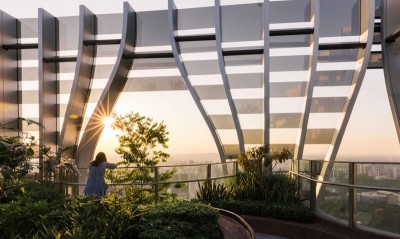
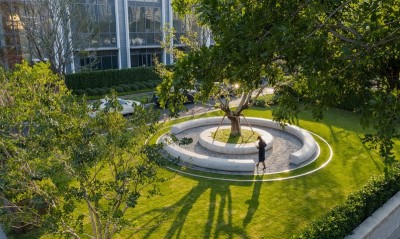
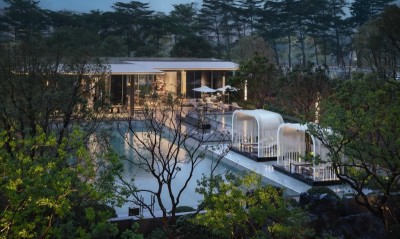
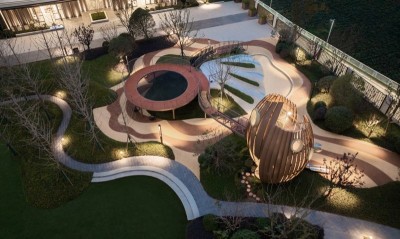
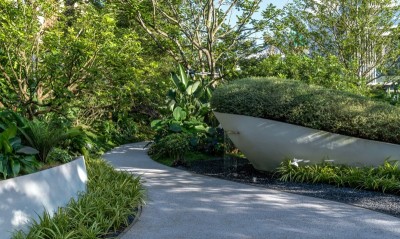
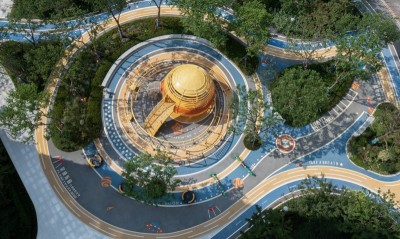
The Colorful Guizhou City demonstration area in Guiyang treats the region's ethnic and geological inheritance through deconstruction and rebirth, animating a spirit of place that tells the story of Guizhou. Natural memory points are read both as the earth's beautiful fractures and as the karst caves that gave birth to multi-ethnic culture. At the Cloud stage, the Buyi ancestors' wisdom of building stone from local materials inspires a sculpted entrance portico set against a black-and-white backdrop that the designers read as colorful; interlacing motifs drawn from bamboo baskets and fishing nets evolve into structural symbols of the gate, while stalactite-wrapped supports and a floating portico collide visually and express karst's own tectonic logic. At the Water stage, fractures become the skeleton of the place: people walk through a canyon, reinventing the mountain spatial experience and enacting a philosophical parable. The canyon is wrapped in terraces that cascade down in layered waterfalls, expressing the kinetic energy of Guizhou's landscape. At the Mountain stage, a side field initially intended as a clean performance stage with curtain and lighting has unexpectedly become the liveliest spot of all, hosting weekly barbecue gatherings organized by the marketing team. At the Forest stage, the Butterfly Mother, symbol of Miao cultural origin, dances beneath the trees, her sculpture anchoring the precinct as an emblem of mystery, drama and myth. Landscape entered at planning stage: the sales gallery was reoriented so that its display edge and traffic flow could be improved, with feature walls and planting screening inward views to form an introverted, high-quality landscape. The gate was modeled repeatedly in BIM and scene software, then prototyped, fabricated in steel, transported, assembled and welded on site; the sloped water surface was optimized from solid stone cladding to precast elevated beams, solving both linear fluidity and later efflorescence.




 Editor's Pick
 Latest Design