Text description provided by the architects
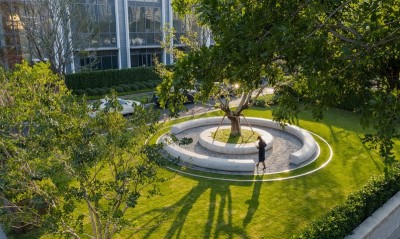
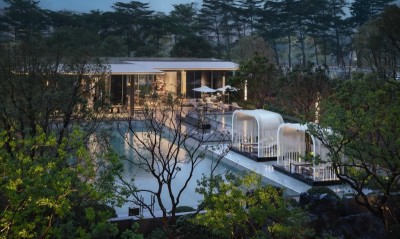
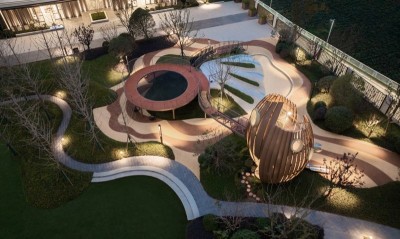
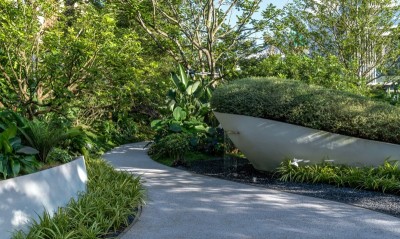
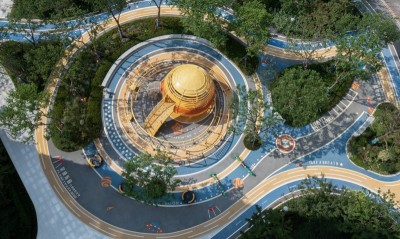
Sunac & Shoucreate Wuhan Jiupai Jiangshan Yi Jiangfu is a residential landscape on the south side of Jingkai Avenue in Wuhan's Economic Development Zone, next to a metro station and facing the Yangtze River to the southwest, designed by Guangzhou Guanji Landscape Design. Before site design began, the team spent more than a month with Sunac Central China researching Chu culture, exploring the romantic life of the Chu kingdom through five lenses: space, form, ornament, colour and daily life. The resulting scheme reshapes the spatial charm of Chu from the romantic imagery of the Songs of Chu into a contemporary dwelling, exploring a more poetic way of living. The site already held a two-hundred-year-old hackberry tree that creates a 2.6-metre grade change; the designers exploit this as the natural stage for the classic Chu story of 'high mountains and flowing water, seeking a soulmate'. Arrival begins with a bamboo path, quiet and secluded, where the noise of the city falls away as if crossing into another age. Following the path, the ancient hackberry appears from afar, its thick trunk holding centuries of memory, sunlight dancing among leaves. The tree is the high point of the site; beside it a terrace, and below the terrace water, so that the cantilevered platform and falling water seem to burst through the heavy perimeter wall and pour into the ancient Yunmeng marshes. The layered pavilions recall the Songs of Chu: high halls and deep chambers, winding corridors, terraces rising against the mountain. The front water court is woven with green islands and mist, evoking the ancient lake groups of the Jianghan plain; at sunset, boat-shaped lights float on the water like fishing lanterns on Yunmeng marsh. Walking forward along the stone path laid across the water, one reaches the residential entrance; beneath a warm timber ceiling, looking back gives the bamboo path, looking sideways the tall hackberry. Through the warmly lit lobby, the grandeur relaxes into winding, babbling streams that carry boat lanterns through green trees to a distant pavilion. The rear pavilion is plain in construction, like palace forms painted on Warring States bronzes: wide, gentle eaves, open undersides, close to nature. Its lattice uses the diamond motif so central to Chu culture, representing the North Star worshipped by the Chu people and woven into clothing and bronzes in countless combinations. Landscape lights in the water read as boats from the side and as que towers from above. The walk returns past cascading water and up steps to the hackberry, moving from grandeur to calm to depth, leaving the romantic, unhurried and soaring spirit of Chu in the resident's memory.




 Editor's Pick