Text description provided by the architects
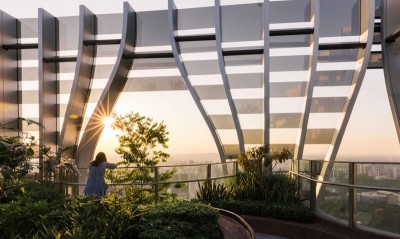
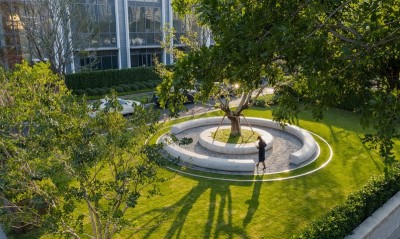
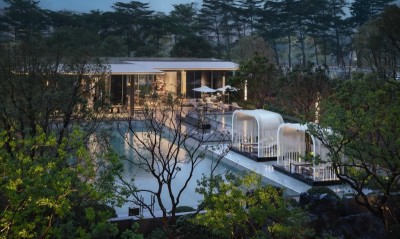
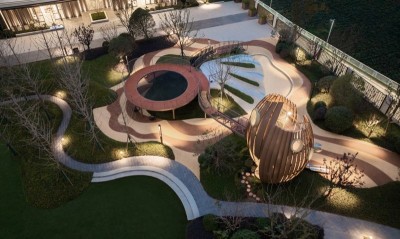
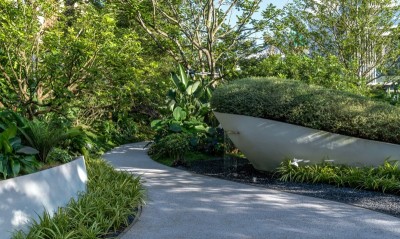
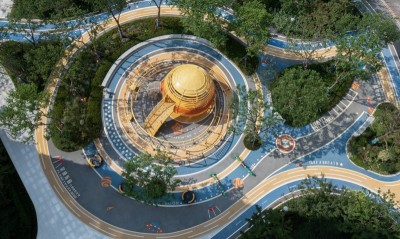
Shougang Yunshang Jianglai is located in the Yuelai group of Chongqing's Liangjiang New Area, directly beside the Jialing River. The site offers over 400 meters of waterfront, with an east-west elevation change of 27 meters that generates ten terraced building levels and a complex multi-dimensional sightline system. The main entrance exploits an 8-meter grade change to compose a mountain-water painting: semi-transparent steel grille curtains simulate mountain forms, paired with varied water effects, condensing a 70-meter journey into a landscape scroll. Through runoff analysis, the team enlarged catchment and narrowed the falling-water plane to prevent splashing onto the road, and adopted 5-mm light-gold aluminum panels with misting nozzles. A 30-meter-wide viewing axis toward the river uses approximately 200,000 pieces of Binzhou-blue natural stone in three sizes with V-joints, and nearly 500 small recessed spotlights arranged on the arc to produce a starlight effect. The stone-forest section stacks weathered rock with naturalistic planting for a rustic, wild charm; slate-clad walls use 50-to-200-mm slabs with pointed capping. A roughly 980-square-meter infinity water feature spans the building roof and ground, requiring integrated structure, pre-embedded pipes and precise planter positions; five glass skylights totaling about 100 square meters, with a maximum span of 4.6 meters, use 19+1.52SGP+19 ultra-clear laminated glass with glass ribs, waterproofed through SGP wrapping and full welding. Retaining walls across the site use about 8,000 square meters of dark gray 20-mm slate in irregular 200-to-500-mm panels with 2-cm joints, secured with mesh and steel pins. River-view platforms preserve existing slope vegetation. Planting draws on Yu Guangzhong's Yuelai imagery: banyan, tallow, plum, peach, pear, begonia and loquat. The designers spent a year making fifteen trips across four major seedling regions, locating twelve naturally crowned banyans, 157 flowering trees, 116 fruit trees, 94 native tallow trees, 65 camphors, 21 red maples, 42 jacarandas and specimen podocarpus. The scheme was designed by Zhu Yufan and detailed by Zhilan Landscape over three years.




 Editor's Pick
 Latest Design