Text description provided by the architects
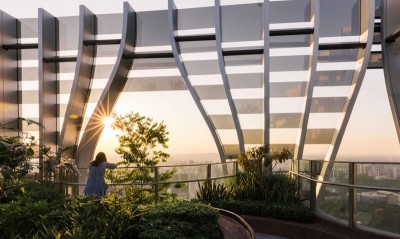
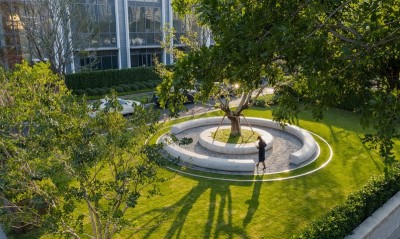
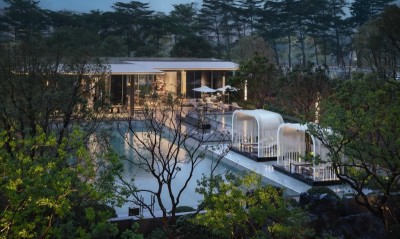
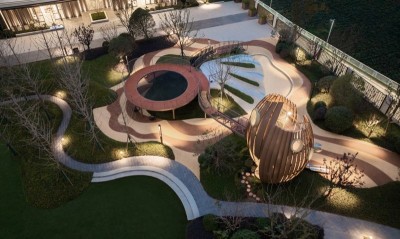
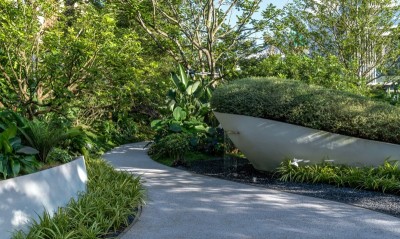
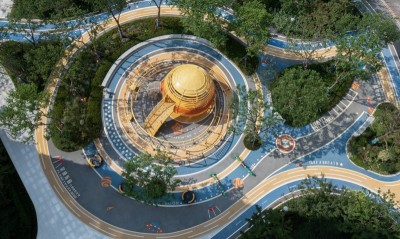
Plot 1 of the New Hope 3D City in Wenzhou, Zhejiang, is a residential landscape designed by Zhilan Landscape and built by Yongji Yuanye Landscape, for developer Yongji Wanxin Hengjin. The project is organised around the human desire for water and city, and aims to reconnect residents to nature on a site overlooking the Ou River. A raised viewing platform, with wood-grain transfer-printed bar and wine-red leather stools, evokes a California coastal mood where residents can listen to the river and watch neon reflect on the water. To avoid structural overload, lightweight children's play equipment is chosen over heavy fixed structures, paired with sea-blue surfacing that makes children's dreams feel light and cool. Backlit perforated aluminium panels stand like translucent veils, and tree shadows slip across the transparent feature wall; from the front, the same grille reads as a heavy white cement wall, and its rhythmic light movement is paired with a bamboo grove so that natural, rounded curves feel almost weightless. The broad Ou River flows east, and the river wind enters the courtyard and wraps the residential approach. A classic white-and-grey palette organises an elevated courtyard, and a continuous jogging loop runs through the whole site, its flowing curves allowing residents to hear wind and bamboo while moving. Public space is treated not only as a circulation route but as a neighbourhood living room: rest pavilions are distributed across the site, grouped around grilles and fresh planting to form semi-open places for casual conversation. A community exchange space is created around low ventilation shafts using cantilevered steel and matching grilles, lifting what would otherwise be awkward service structures into pleasant social places. Because the whole building is a mixed commercial-residential complex, the ground-floor plaza also serves surrounding residents and shoppers. Planting follows comfortable, semi-circular clusters that rise in height like waves, so that all life above the river bend is given rounded, gentle curves. The project is a work of rational, iterative problem-solving: the site is deconstructed, nature and everyday life are reinserted, and the whole is rebuilt in a fluent, natural language, from the smoothed curves to the repeatedly tested grilles, producing a compromise with reality that refuses to give way.




 Editor's Pick