Text description provided by the architects
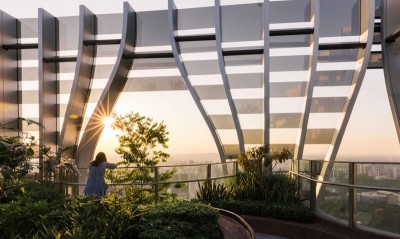
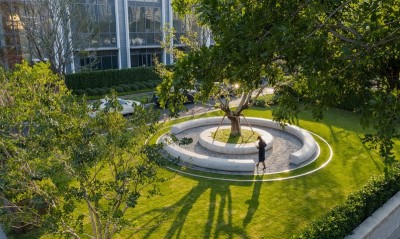
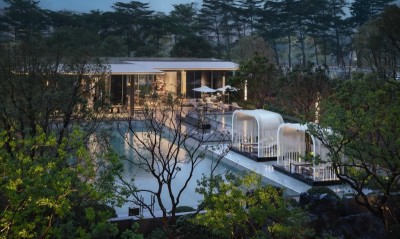
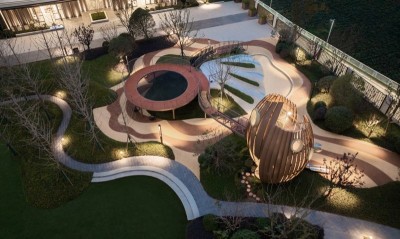
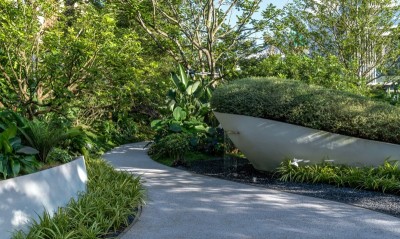
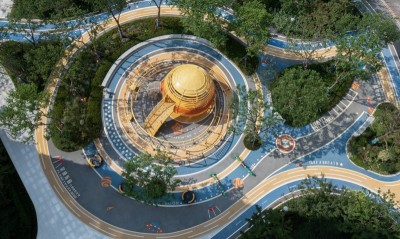
New Hope D10 Tianfu rises along Dongda Road in Jinjiang District, Chengdu, on the so-called Fifth Avenue axis east of the Chunxi Road business district, a position that carries the city's most contemporary and future-facing urban identity. Designed by Chengdu Zhilan Landscape with contractor Sichuan Jintianxia, the project deliberately rejects historicizing motifs while preserving a Chinese xieyi, or expressive, sensibility: linear curves that rise from the site's cultural background, pass through modernity and reach toward the future, shedding past stylistic schools. The design enters into a subtle dialogue between landscape and architecture, introducing refined curves that unfold like the Fibonacci sequence across plan, section and construction. Unlike the Chunxi-Taikoo Li district, which emphasizes traditional urban atmosphere, D10 is positioned as the vanguard of a high-end modern community, its landscape extending and infiltrating into the city. Where Chinese gardens are about culture and lineage, D10 is about the future and about the harmony between people and nature, drawing inspiration from Ansel Adams' photographs in which nature itself reads as science fiction. The project blends wild natural elements of water, light, cloud, wind and valley with the geometric cuts and curves of industrial technology. Layered vertical circulation is the central challenge: the front court uses a pink-ink palette of flowering shrubs and black obsidian-like walls, with the distant lotus-crown building dome as a magnet; the middle court stages a runway-like promenade where water and light produce a time-tunnel effect; the sunken courtyard, the most difficult space, is reimagined as a mountain stream and cloud valley, bringing light and natural texture to a previously oppressive void. The two-year project integrates parametric design, new materials and craft, producing a multi-layered future garden that links urban glamour with regional nature and culture.




 Editor's Pick
 Latest Design
 Best Idea