Text description provided by the architects
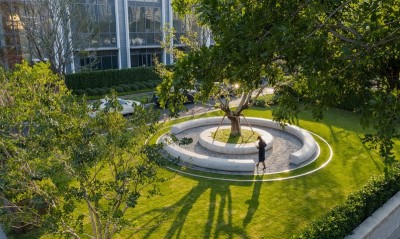
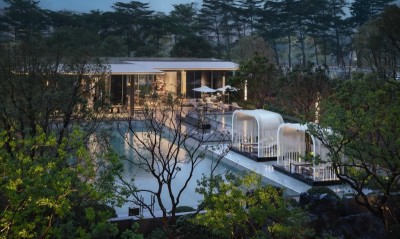
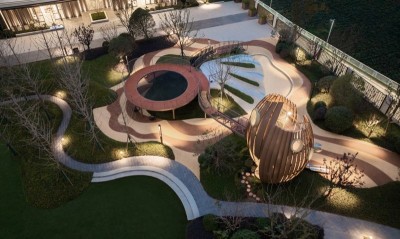
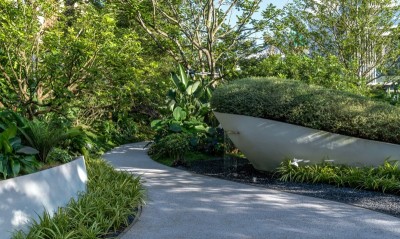
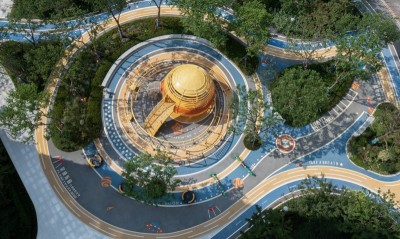
Vanke Future Light is a 3,721-square-metre retail landscape in Shenzhen's Qianhai hinterland, on the Jiangangshan ecological hill district north of Yangtaishan Ecological Park and looking toward Tiegang and Xili reservoirs. A&N Landscape, working with interiors by ENJOYDESIGN and contractor Guangzhou Pubang, was asked to compensate for the limited public amenities in a low-density, high-green-rate enclave of luxury villas. Borrowing Ray Oldenburg's idea of the third place, the design treats the street as a shared living room, open, warm and capable of hosting different users at every hour of the day. The landscape is organised around six cinematic fragments. First, light falls on a boundary-less living field: a square pavilion sits among cascading water, and a golden gift-box art object blurs the edge between street and commerce, while existing large trees are preserved as far as possible. Second, social life expands: wooden decks under the shade invite afternoon tea, dog walking and neighbourly conversation, with tall, slender acacia trees chosen to keep sight lines open. Third, street-level warmth: the original U-shaped site was reworked into an L-shaped loop, and alternating bright and dark passages create surprises. Fourth, the corner where green meets street: existing planting is woven into the municipal road to form an oxygenating pause. Fifth, the forest-island theatre runway: warm terracotta walls borrowed from the architecture are repeated at turns and framed views, and night lighting turns the block into a theatrical stage. Sixth, Miracle Lane: tropical miracle trees and ground lights set off a garden-retail mood, with seating for quiet conversation. A sponge-city layer runs through the whole scheme: eco tree grates, permeable channels, constructed wetlands, rain gardens, sunken green and educational signage explain how stormwater is collected, retained, cleaned by PP storage modules and reused for irrigation. A children's water-play tap closes the loop. Existing albizia, araucaria and flame trees are kept, and the planting palette favours tall, narrow southern species to keep sight lines open. Pet-waste bins, drinking water and resting nooks support a warm, lived-in street. The project is a post-pandemic argument for a third place that is both ecological and emotionally restorative, a Chelsea-garden-like retail strip where the past and the future meet in everyday life.




 Editor's Pick