Text description provided by the architects
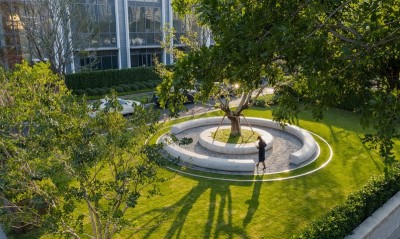
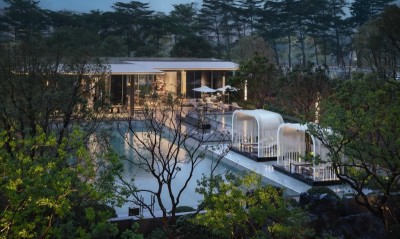
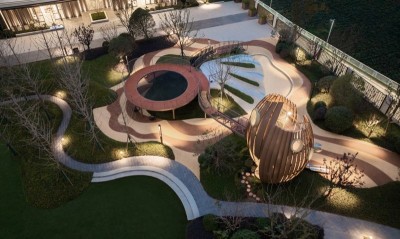
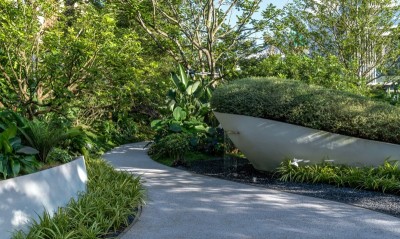
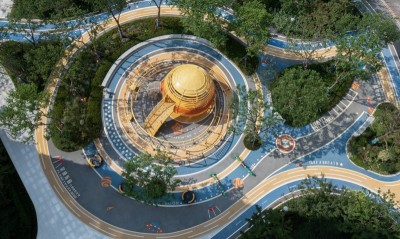
Jinke Hanwang Tingquan Town is in Hanwang, Xuzhou, the birthplace of Han culture where Emperor Liu Bang founded the Han Dynasty, leaving behind such heritage sites as GeFeng Terrace, the Sword-Drawing Spring and Opera Horse Terrace, and a living tradition of Han costume, dance and music. The client team is led by Zhao Ning, Liu Mufan, He Qingxi, Zhang Yu, Liu Xiaoye, Huang Can and Wang Hao, the landscape by ACA Maiken Landscape's Second Studio, and the contractor is Chongqing Zhanhong Garden Engineering. The 11,486-square-metre first phase must both showcase future community life and cultivate a commercial street atmosphere, and the design responds through light intervention and new translation, inserting a "national-trend show stage" that carries history while inviting contemporary use. The circle is chosen as the unifying symbol - a figure of completeness, openness and connection between past and future - and curved lines derived from it break the rigid symmetry of a typical site. The first act draws on the Sword-Drawing Spring story: rather than a large installation, the landscape steps back and lets a Jiangnan-style architectural facade become the opening image, floating above an open civic space. At the corner, a waterscape of leaping and cascading jets tells the Liu Bang and Xiang Yu story; when the music fountain runs the square becomes a stage for children, and when it stops it is an urban plaza open to the city. The second act is a six-metre stainless-steel dancer in sweeping Han sleeves, animated through 3D simulation and printing so that it echoes the musical fountain. The third act lights the transition from outer to inner commercial street with four hundred star-like orange lights arranged in curves. The fourth act is a falling dancer made of square stainless-steel grilles, the bookend of the story, and the fifth act is a modern vortex water feature at a sunken plaza whose bar and stone seating form a living room for the community. Together they stage a new national-trend Han-style theatrical street that revives the glory of old Hanwang.




 Editor's Pick