Text description provided by the architects
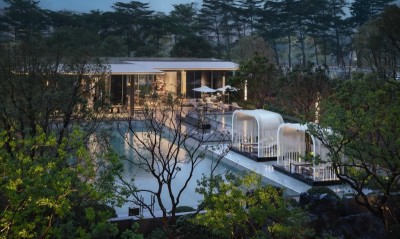
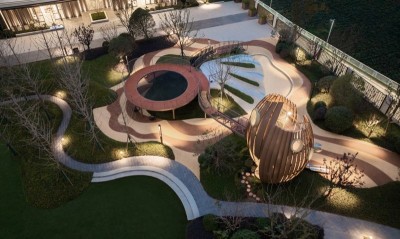
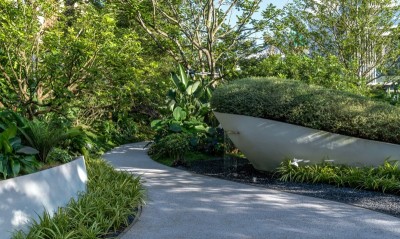
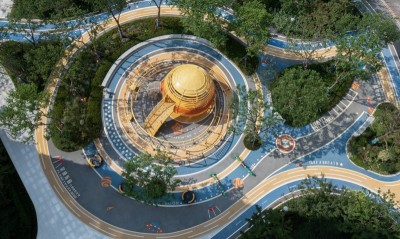
The Royal Lan Terrace by Territory Holdings is a residential landscape that stages the ritual language of a Qing-dynasty imperial garden on a site in Zhumadian, Henan. Zhumadian sits in the geographic heart of the ancient Yuzhou province, one of the cradles of Chinese civilization, surrounded by the ancient capitals of Luoyang, Kaifeng, Anyang, and Zhengzhou, and carrying myths of Pangu and Fuxi. The design anchors itself in this imperial-garden lineage, specifically referencing the Summer Palace's Harmonious Interest Garden and the mythic isles of Penglai. The approach begins with three cloud steps, evoking steady advancement in official career, paired with three cascades, each holding a stone beast cupping a spring, symbolizing first-place examination success; welcoming pines on the cascades signal ceremonial welcome. The gatehouse references the shape of an imperial mian crown, rising more than three metres above the enclosing wall for maximum visual impact, and introduces a fuyi screen wall painted with the Penglai immortal landscape. Feature walls stretch dozens of metres on either side, linked by grilles so that views through them are half-concealed, producing a step-by-step shifting scene. A sixty-metre water feature with a small bridge reads as a handscroll floating on water, while the hundred-plus-metre frontage reinforces the palace-gate presence. Beyond lies Ruyi Three Mountains, its pool edges decorated with ruyi motifs and its centre holding a miniature of the three Penglai isles; palace lanterns and planting line the approach in orderly arrays. The second gatehouse uses a wudian hip roof, permitted historically only for imperial and Confucian halls, its 23-metre ridge evoking the image of a great roc spreading wings. Inside, Shuifang Rock and Spring, a screen wall of layered rock with trickling water and koi, announces the Penglai motif; a winding path through dense planting and spring-fed channels leads to a pavilion open on all sides, its north wall of bamboo, its south carved as a crape-myrtle lattice screen. Corridors extend from the pavilion, hung with screens depicting A Thousand Li of Rivers and Mountains; by day sunlight filters through the myrtle lattice, by night lanterns transform it into a field of stars. A waterside platform with meiren-koi bench and a stone barge motif invoke Wei Zheng's maxim that water can carry or capsize a boat, while the stone barge symbolizes unshakable prosperity. Three ripple zones in the pool represent the Penglai, Fangzhang, and Yingzhou immortal isles, and a long bridge carved with white marble cloud patterns crosses to the sales centre, whose five steps and cloud platforms invoke the nine-five dragon-above-heaven auspice. The rear garden uses gravel in place of open water, with rainbow bridges at narrows and small cascades evoking Li Bai's poem of twin mirrors and twin rainbows.




 Editor's Pick