Text description provided by the architects
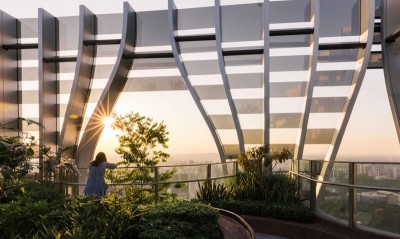
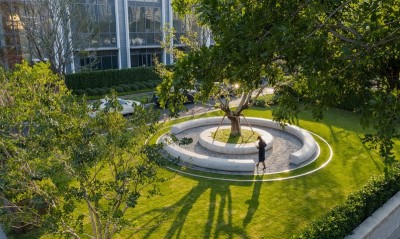
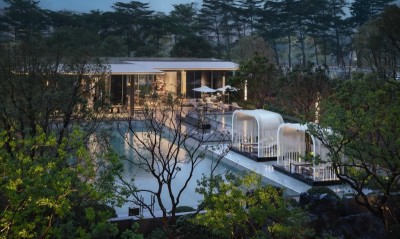
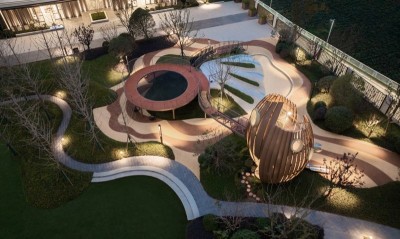
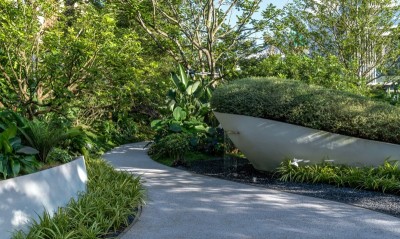
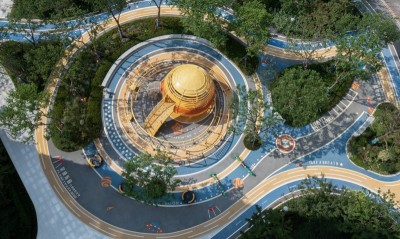
Jinke Jimei Lanwan in Jining, Shandong, is set in a region deeply marked by Confucian culture and by the Sishui springs, where the ancient philosopher is said to have taught and exclaimed that time flows on like a river, day and night. ACA Maikeng Landscape organized the design as one tour through four realms: mountains gathered into the frame, springs of the Sishui forest, bridges across the Sishui court, and a secluded sacred spring valley. Because the site is in a third- and fourth-tier city, the budget was tightly fixed at 800 yuan per square meter for the display area and 420 yuan for the rest, pushing the design toward a restrained, straightforward expression that preserves quality without unnecessary expense. Two problems had to be solved at the front: the sales gallery faces north-south while the main display interface runs east-west, resolved by a sequence of light-and-shadow walls as the display facade; and the front area sits inside a municipal green space that will later be removed, so it is designed as a forested park that works both as a passage and as a place to linger. Visitors approach from the south of the city through the Sishui Bin Park, and the design borrows that park and the northern forested mountain backdrop to fold the project into its larger setting. Confucian ritual order is translated through arrays of trees and perforated frame structures, in a flat, narrative sequence that uses spatial insertion and shifting light to express restraint. Looking north, the site backs onto Longmen Mountain; the designers borrowed its hazy silhouette to draw visitors toward the gallery, and paired the light-shadow walls with the blessing pavilion of Sishui Bin Park. A blank wall, a single rough stone and a leaning tree replace ornament: the shadow of the tree on the wall becomes a living painting that changes by the hour, more vivid than any carved feature. In the spring-forest realm, the team let woods precede paths and paths precede human activity, so that spring and forest respond to each other. Because the Sishui River lies a hundred meters to the south, the design brings water into the courtyard as a thin axis that gathers a hundred streams and bubbles back out of the ground, symbolizing the river's endless flow. Brushed glass carries a hazy beauty like layered waterfalls, and at the southern edge a winding Bian bridge opens onto a flowering valley of trees and flowers.




 Editor's Pick
 Latest Design