Text description provided by the architects
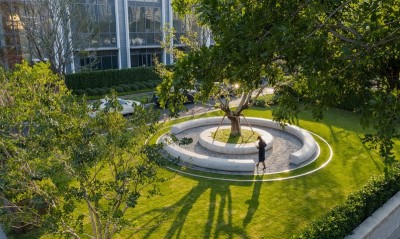
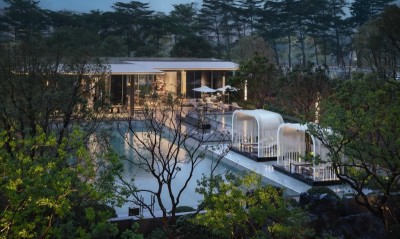
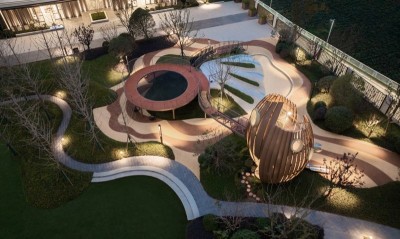
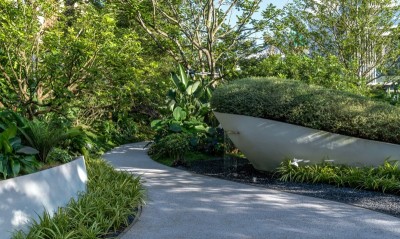
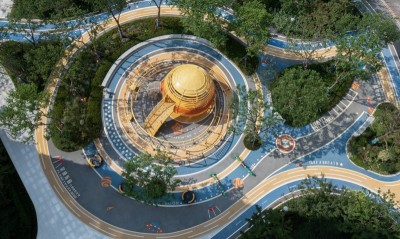
Ledi Landscape by Territory Holdings in Leshan, Sichuan, is a modern neo-Chinese garden that draws on the natural and cultural identity of the old town. Leshan, anciently called Jiazhou, is known as the land of the fragrant crabapple, set where the Min, Qingyi, and Dadu rivers meet and between Leshan and Emei mountains; Emei Scenic Area and the Giant Buddha offer a natural and historical legacy that shapes local life. The design for Lanyun reads these three rivers and two mountains as the starting point for a relaxed, cultured residential life, and combines new-Chinese garden innovation with local leisure traditions. The landscape is organized as Nine Scenes of Lan: Auspicious Beast Offering, Jiazhou Impression, Lanshan Painting Scene, Light-and-Shadow Corridor, Lan Pavilion Tea Inquiry, Big Fish and Crabapple, Starlight Cascade, Forest Lan Court, and Zen Lan Courtyard. The name draws from The Literary Mind and the Carving of Dragons, in which pearls hidden beneath the water make ripples square or round, suggesting hidden inner quality that manifests subtly at the surface. A five-entry return-home ritual stages the promenade. The main entry is set back from the road behind an enclosed forecourt of wall panels, water, and stone guardian beasts, creating a layered sequence rather than a direct gate; white marble Pixiu and water-subduing beasts flank the porte-cochere, whose sloped roof derives from western Sichuan vernacular. A layered rockwork in the gate plaza reads as a miniature of the city's three-rivers-two-mountains topography, with a sculptural luohansong pine reflected in water. Through the gate, a dynamic spirit screen replaces the static traditional wall: rockwork, cascading water, pines, and koi create a living landscape scroll. A stone stair corridor leads into a light-and-shadow gallery where crabapple-pattern dappled light evokes A Thousand Li of Rivers and Mountains. Mid-gallery sits Lan Pavilion, its hollow lattice roof admitting sun, with a sunken water bar reached through a moon gate; the pavilion, rock cascade, starlight waterfall, and sales centre enclose a Mirror-Water Moon court in the four-returns-to-hall arrangement of Jiangnan gardens. In the central court, a Big Fish and Crabapple sculptural group depicts fish circling a crabapple tree and leaping over the waterfall, invoking the carp-leaping-the-dragon-gate metaphor. A curved cascading water wall, read as an unrolled Chinese handscroll, separates the mid-court from the rear, allowing visitors to walk through the falling water. The result is a contemporary literati garden that fuses natural scenery, poetic allusion, and humanistic detail.




 Editor's Pick
 Latest Design