Text description provided by the architects
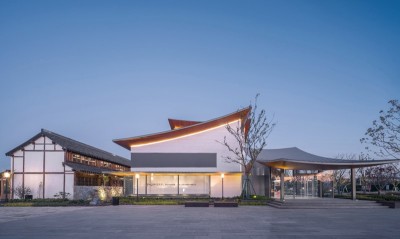
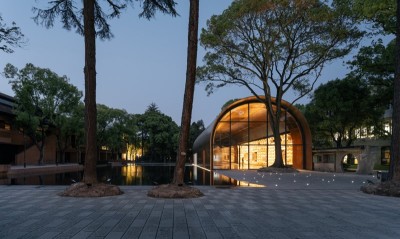
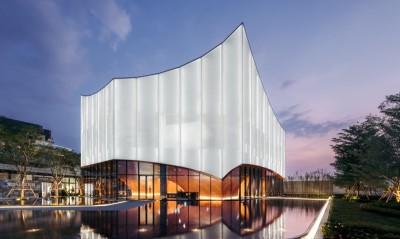
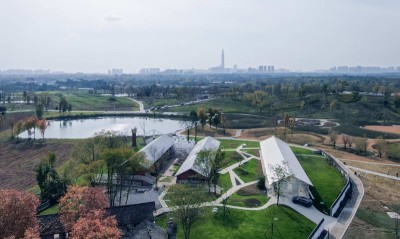
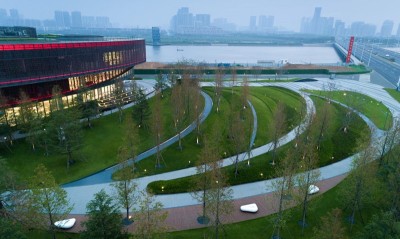
The China Good Grain and Oil Exhibition Center sits at Tanjianian in Xinhua Village, Chongzhou, about fifty kilometers west of Chengdu, in a classic Chuanxi linpan landscape: dispersed farming settlements of groves, courtyard houses and surrounding paddy fields, a living pattern of production, dwelling and scenery that has defined the western Sichuan plain since the ancient Shu civilization. Designed by Xiao Yin Architecture for Sino-Rui Jinye Cultural Tourism, the center is itself conceived as a modern linpan emerging from ten thousand mu of farmland. Four courtyards are formed by preserving existing trees and letting architecture and planting interpenetrate, so that groves contain courtyards and courtyards contain groves. The core strategy is return: most of the ground floor is lifted on pilotis, giving the ground back to nature and to people. The main building is broken into five small independent volumes scattered across the site, the original trees interweaving with them; the four ground-level courtyards multiply into nine elevated and sunken courts that bring field ridges, paddy plots, planting beds and trees into different levels and moods. A central ramp and an external loop corridor string the five volumes together, with solid inner walls facing the ramp and fully glazed outer walls facing the groves and paddies, producing a sequence of closed and open, intimate and expansive spaces. The architects deliberately preset multiple operational and programmatic possibilities so that the center can thrive as a community hub rather than becoming another underused rural public building. Local Sichuan-residence motifs of grey tile, white wall, wood, deep eaves and sky-wells are fused with curved pitched roofs and floor-to-ceiling glass, yielding a light, transparent, poetic rural setting. At night, the glass facade glows like a lighthouse over the paddies, and the lifted courtyards, plazas and corridors become places for elders to cool themselves, residents to dance and children to play, including an accidental shallow-pool water garden. The project is intended to be both a grain-and-oil exhibition space and a communal center for the surrounding villages, returning more value to the land than it takes.




 Editor's Pick
 Latest Design