Text description provided by the architects
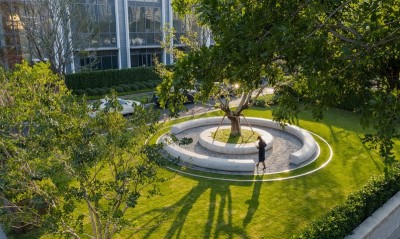
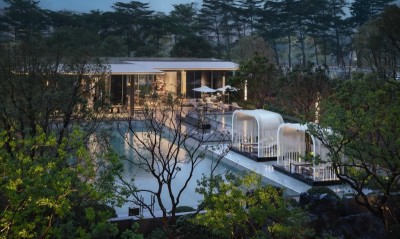
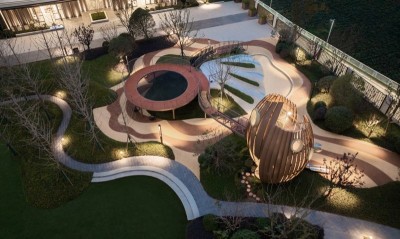
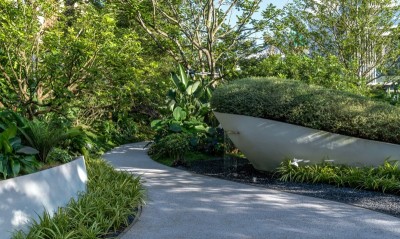
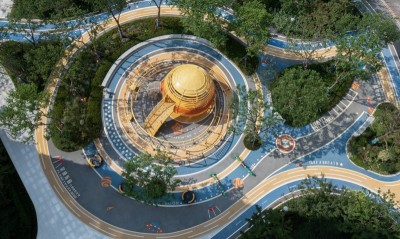
The overall building of Hongxing Borui Garden in Jinhua is an enclosed volume, and the main entry and sales pavilion sit at right angles; the landscape by HWA uses arc elements to lengthen the experiential route from gate to sales pavilion, threading functional nodes along the way. Alternating solid and void, opening and closing, the movement gives the sequence a musical rhythm, and every turn offers a different scene and a different personal reading, carving out a pure, quiet, released spiritual space. Beyond the city's noise, between light and shadow, the mirror world asks whether it is real or dream; meeting mind to mind, one seeks stillness. The sky mirror is not distant: sky and earth are as clear as amber, and looking down one sees another sky. When no wind stirs, the still water has not a ripple, and walking across it feels like walking on the horizon, sky above and sky below. Water is the soul of the place: its mirror links sky, trees and building, making the tight site feel open, and reflections of architecture, branches, stars and sky mirror the visitor's own inner state. The moon-over-water is a pavilion on the water, less a full moon than a rippling, touched reflection, asking which is more real, above or below. Interactive play devices enliven the children's area and become the place's memory point, letting children's innocence and freedom dissolve into endless joy. The alternation of spaces gives a smooth, rich sequence, and residential entry courtyards offer rest, conversation and prospect. Neighboring trees and flowers, breeze and moonlight, birdsong ease body and mind, and belonging returns. Water, like a vessel of light, records time from dawn to dusk, from branch to surface, in a change that is gentle yet full of natural force.




 Editor's Pick
 Latest Design