Text description provided by the architects
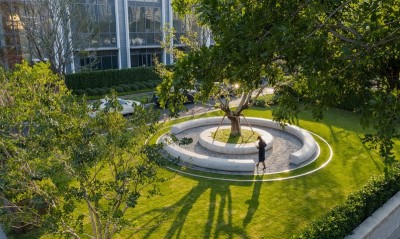
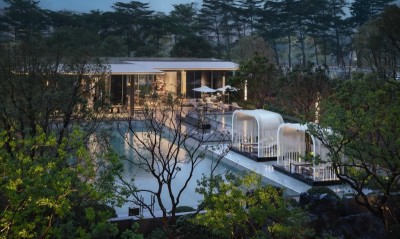
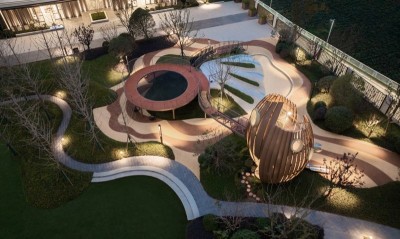
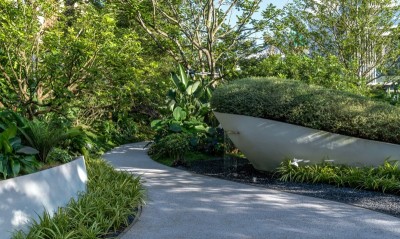
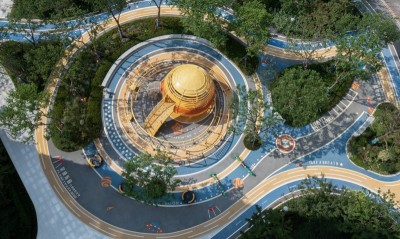
The Excellence Mintai Yunyi residence in Shenzhen's Bao'an District sits on a narrow, triangular 3,112-square-metre showroom plot on Hangcheng Street, hemmed on three sides by industrial parks and surrounded by flat, sparsely planted ground. The design problem was how, in such a noisy, cramped setting, to stage an entrance sequence that visually pulls visitors inward, lets the building step back, and extends a sense of nature despite the inhospitable context. After analysing the city, geography, and site conditions, the team proposed a concept of reviving the site through aesthetic revelation, built around a theme of purity and stillness. Geometric proportion, the unbounded quality of light and shadow, and a restrained modern vocabulary are combined to produce a poetic natural living space whose beauty lingers in memory. At the entry, a tall totem forms a visual anchor, while hoardings and planting on both sides of the road draw visitors' sight inward, immersing them in a dense forest that screens out the industrial surroundings. Inside, the language turns to pure geometry: clean linear surfaces replace ambiguous decoration, and linear lighting at wall junctions intensifies the sense of space. White landscape grilles and black cascading feature walls share a formal language while contrasting in tone, reinforcing one another. The relation between landscape and building is mediated by planting, water ripples, social space, and art, so that the building seems to grow from the forest; water and groundcover soften the interface, and reflections bind architecture and landscape into a single, symbiotic whole. Tallow trees act as guides, linking outer landscape to inner promenade; as breeze moves through them, trees and walls perform a quiet metrical rhythm. Planting follows the new-naturalism tradition of Weimar Schede, using dwarf agapanthus, hydrangea, blue sage, and variegated hosta in naturalistic blocks, so that light and shadow play across the mass. Completed and opened in 2022 with landscape by Weima Design Shenzhen and architecture by Shenzhen Diwu, the project argues that in a fast, post-pandemic city, art and aesthetics are the most reliable antidote to spiritual exhaustion, and that even a tiny, constrained urban site can become a place where walking slowly, looking carefully, and noticing beauty becomes possible.




 Editor's Pick