Text description provided by the architects
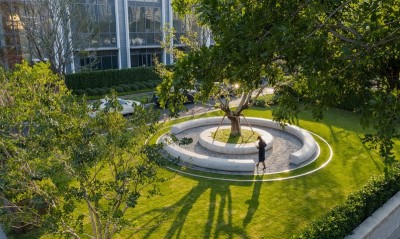
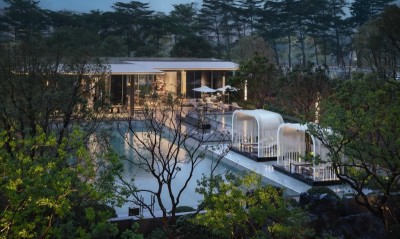
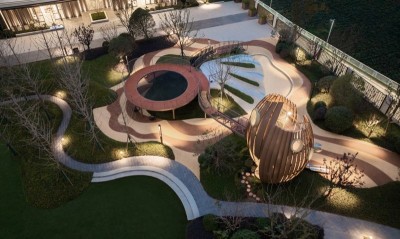
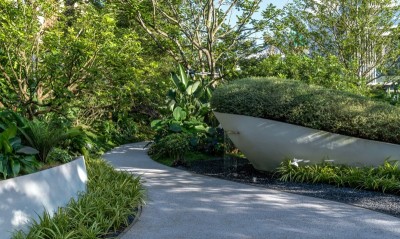
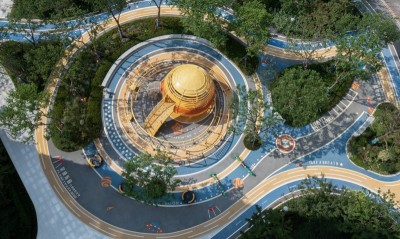
Inspired by the landscape traditions of Nanjing's Qinhuai River basin, Hongyang Xiyue in Lishui District, designed by Weima Landscape's Nanjing branch and completed in 2020 on 3,050 square metres at Xiaoximen Street, shapes a residential landscape that fuses modern refinement with classical Chinese mood. Lishui, upstream of the Qinhuai River, is known as the natural oxygen bar and back garden of Nanjing, with lush ecology and waterside scenery. The design uses mountain form to compose landscape mood and water movement to sculpt garden spirit, optimising the site through a sequence of entry, adaptation to terrain, garden building, scenography and shaping. The building is arranged around a courtyard, and modern techniques weave natural water and rock elements into an immersive, progressively unfolding promenade where every step reveals a new scene. At the First Gate, an elegant homecoming portal emerges beneath tree shade, its horizontal frame enclosing an airy inner garden; feature walls in the style of Chinese borrowed scenery divide the sequence, while grilles, layered stone and planting evoke a mist-shrouded ink painting. At the Water Courtyard, winding paths wander as if inside a scroll, underwater lights rippling across mirror surfaces that extend vision into the distance, using classical framing, opposite-view and enclosing techniques to fuse building and landscape. At the Cloud Pavilion, mist rises beneath the eaves and Chinese tallow trees cast shifting shadows on the walls. In the Rain-and-Mist zone, black mirror-stainless strips trace the motion of cascading water, while low greenery, black gravel and pale paving unfold a quiet corridor punctuated by flowers. Construction was tightly controlled: ground preparation, pools, road bases, pool tiling, road surfaces and planting layout were executed to landscape engineering standards, with a refined plant palette combining formal and natural arrangements. The entry stacked-stone feature was arranged by a master craftsman three times to achieve interlocking joints and hollowed, expressive rockwork. The result is a refined waterside dwelling that gathers the scenery of Lishui and its Wuxiang Mountain within one garden.




 Editor's Pick
 Latest Design