Text description provided by the architects
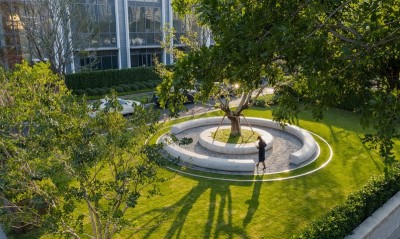
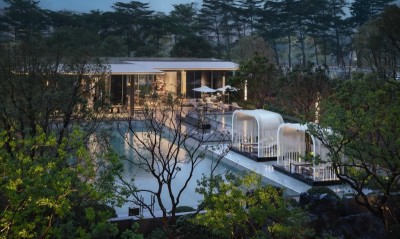
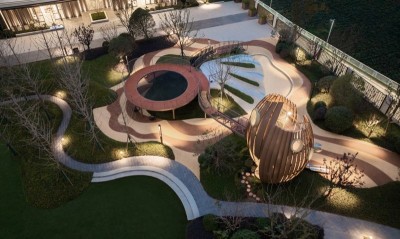
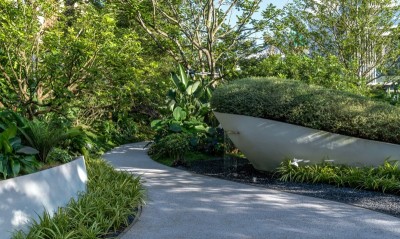
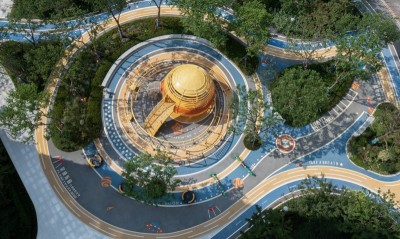
Jinke Jinhongji Feng Hua is located in Jinzhou, Dalian, a two-thousand-year-old district bearing thick historical memory. The surrounding urban fabric is aging; the front area adjoins an elevated highway and temporary sheds that obscure the building, and a low opening causes vehicles to speed past. The design strategy must revitalize the site, extend its boundaries and restitch local relationships. Under the theme Free Extension, Return to Essence, the team weaves spatial mood, light changes and water-mirror imagery into the site, extending natural perception, artistic spirit and human-centered perspective. A large dawn-redwood forest combined with a water mirror forms a natural barrier connecting architecture, nature and site, blurring edges while muffling the highway. From afar the site reads as a floating artistic landmark. A clean, restrained central water court holds a single specimen tree, echoing introversion and minimalism, evoking the concept of nothingness-being-self-forgetting. Warm lighting, rippling water and curved-straight geometry compose a quiet melody. The overall layout extracts architectural elements and uses modernist fluid-curve philosophy, with black-and-white paving that leaves generous visual breathing room. From above, star points glimmer under a green canopy; the dawn-redwood forest guides visitors into a micro-interactive realm. Perceptions are layered: entering from a restrained threshold, visitors discover unexpected flowering abundance. Lawns form undulating terrain that mimics floating clouds, producing earth-art impact. The rear garden uses flowing curves to convey visible life beyond the landmark; soft lighting covers the site evenly. Sculptures appear as if dancing on earth, light and free. Planting mixes Hydrangea Bella Anna, Vitex agnus-castus, Salvia, Aster and Agapanthus for refined texture. The front forest's terrain was refined through model simulation and on-site shaping; rare dawn redwoods were carefully nurtured. Naturalistic planting mixes perennials and ornamental grasses into an Alice-in-Wonderland flower sea. The 8,780-square-meter project, opened in 2022, evolved through repeated scheme revisions and pandemic-era construction into a destination where residents now gather, reshaping the space into an inward artistic dwelling and an outward natural response.




 Editor's Pick
 Latest Design
 Best Idea