Text description provided by the architects
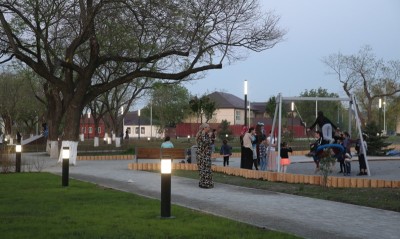
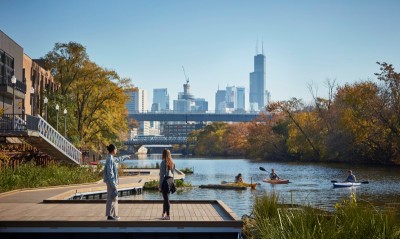
Shenzhen Talent Park, in the Houhai district of Nanshan, is the first city-level public park in China explicitly themed around talent. Bounded by Shahe West Road, Dongbin Road, Keyuan Road and Haide Third Road, it connects to Shenzhen Bay Park and the Shenzhen Bay Sports Centre and sits next to the super-headquarters zone of the Greater Bay Area. On a total site of 777,000 square metres, with 360,000 square metres of water, 325,000 square metres of green and 87,000 square metres of hardscape, the park transforms what was once reclaimed sea and, after 2009, a closed, inaccessible F1 powerboat racing venue into the largest remaining urban green in Houhai. Landscape designer Zhu Jie, who began bidding on the site in 2007 and finally won the inner-lake brief in 2012 and the Talent Park commission in early 2017, insists on a programmatic plainness: the park should be a place residents want to stay, where young people exercise, elders walk and children grow up within greenery and open water. Children can catch fish and shrimp in the pebble shallows, play in shallow pools, use play equipment and learn local plants, so that the park becomes part of their aesthetic formation. The design includes what is arguably Shenzhen's best jogging loop, advanced shower facilities usable by WeChat card, and Japanese-standard restrooms; different walking routes, an open waterside promenade and a shaded outer ring give users choices by sun and weather. A turning point came when tens of thousands of migratory shorebirds arrived on site in May during construction: because the birds prefer sand and gravel flats rather than planted mudflats, the team cancelled the mangrove planting, removed the grass and kept the gravel beaches. The whole park is therefore treated as a continuous surface that supports ecological process while hosting a multi-use civic ecosystem, and landscape acts not as a standalone "park" but as an open urban structure and catalyst. The concept of flow runs through everything: soft curves instead of hard rectangles, ornamental grasses that soften boundaries, and a network of paths that link zones. The tidal plaza is divided by "sea-bird" structures that read as birds flying between city and sea and that double as seating and a dock for water events. With strategies of flow, elasticity and boundary, the design produces a non-static, non-isolated, non-fixed public system: a three-kilometre functional and slow-mobility loop that extends the 15-kilometre Shenzhen Bay coastal belt, and a perimeter that blurs city, park and water. Planting uses deciduous and seasonal species to mark the passage of time in a city whose seasons are otherwise muted: tabebuia, kapok and bauhinia in spring, flamboyant flame trees in summer, reeds and grasses turning pale in autumn, and ceiba, erythrina and bauhinia in winter. The park is left deliberately unfinished, so that spontaneous, un-programmed behaviour can find room.




 Editor's Pick