Text description provided by the architects
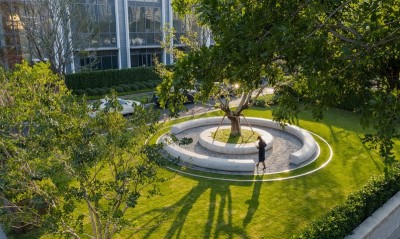
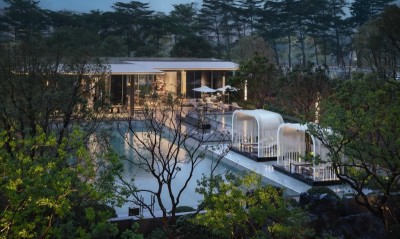
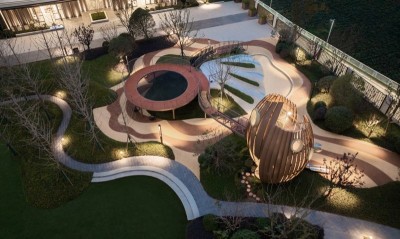
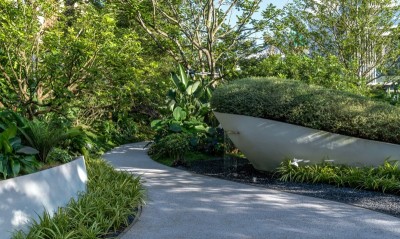
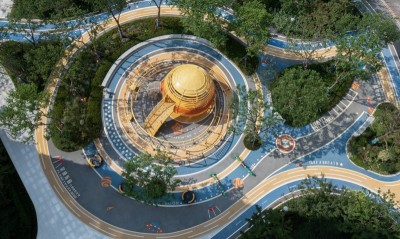
The C19 Honggu'an Show Island at Luhu in Chengdu, designed by JTL Gatlin for client Wanhua New City, is described by the architects as "a place for living, and a work of art". Liquidity runs through the whole site - not as a written slogan or a copied motif, but as curves that still carry an inner firmness, a rounded exterior with a square core. Along the lakeshore, the team avoided a conventional pier: the dock is treated as an interactive field that shares functions fluidly with the whole island. Cantilevered deck elements invite exploration and guide movement through structural tension and rhythmic perforations; seats, frames, steps and plants are all condensed into linear flow. The shoreline itself is restrained in colour, using light, simple tones to approach the water's natural palette; two dynamic curves repeatedly meet and separate so that spaces flow into one another. Planting is deliberately differentiated within the Luhu family: pale feature walls, sandy plants, light gravel and natural stone mark a desert-scape. Tropical plants are risky in southwest China, but after repeated trials cactus, agave, columnar cereus, philodendron, begonia and aloe achieve the intended effect, opening a new landscape experience at Luhu. The island itself is a resting place where custom soft furnishings and considered layout create comfort and healing from urban rush. A rooftop reached by a DNA-like spiral stair that links the first and second floors extends to bar seats, growing naturally out of the building. The courtyard deliberately blurs boundaries between soft and hard landscape, bar and wall, pool and water feature, plants and light, roof and ground. Furniture uses resin and metal in fresh, clean tones with dark accents to support future hotel operation. The pool is pushed back from the water to open views; sun loungers sit in the middle of the pool in shallow and deep zones, supporting swimming, socialising and sunbathing. The project deliberately seeks no fixed path, so every turn offers surprise, and the design language itself is freed from JTL's usual manner - an experiment in a new residential landscape.




 Editor's Pick
 Latest Design