Text description provided by the architects
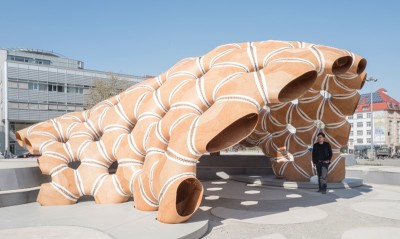
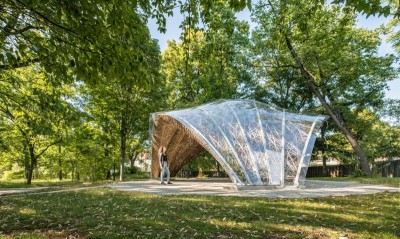
Walking together: the famous street and the everyday market, pedestrians and statues. The Concrete Pavilion is an urban installation furniture custom-designed for the exhibition Heterogeneous Crossing: Duolun Road, a special project of the Shanghai Duolun Museum of Modern Art. The design intervention can be understood as an interpretation and regeneration of the urban scene. The team understands heterogeneity as the excavation of new possibilities from the noisy and chaotic urban context, creating space that generates richly varied scenes. The Duolun Road streetscape today is filled with bronze statues of historical figures, vivid daily life scenes, and the lively behavior of tourists, giving the entire street a rich and noisy street-market atmosphere. The team chose the platform on one side of the Duolun Museum of Modern Art as the site, hoping to create an interactive relationship with the empty seating beside the statues across the street. The aim was to insert a new sculpture that runs parallel to the bronze statues and the complex urban development of the street, while also functioning as a rest place that can be viewed and inhabited. The site is understood as a multi-dimensional space: the street, the lane leading to the rear, the old tree on one side, the building behind, and branches hanging from above. The Concrete Pavilion rises step by step from the ground, extending beneath the nearby tree branches. A semi-enclosed top and a tabletop define two cantilevered eave zones. The lower seating area faces the lane toward the rear buildings, while the upper table-and-seat zone frames a window onto the street. The pavilion itself participates in the urban landscape, becoming part of the background of Duolun Road's main street. The material choice was sculptural concrete. The design process was an attempt to simultaneously explore form, structure, material, and construction. Concrete was chosen for its plasticity, which can produce sculptural forms, while its modernity and rawness both harmonize and clash with the busy street background. Concrete is a fascinating material—it can incorporate recycled waste and offers rich formal variation. Through this experimental construction of concrete urban furniture, the team explored its potential in design, fabrication, and installation, creating a work that is at once sculpture, shelter, and social condenser within the urban fabric.




 Editor's Pick