Text description provided by the architects
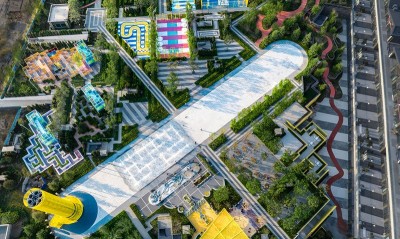
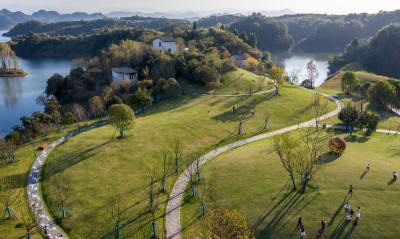
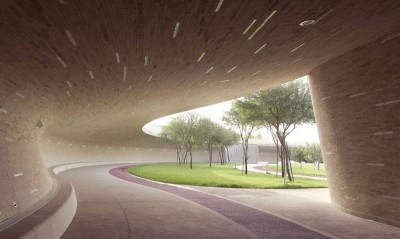
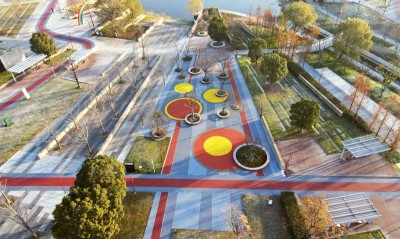
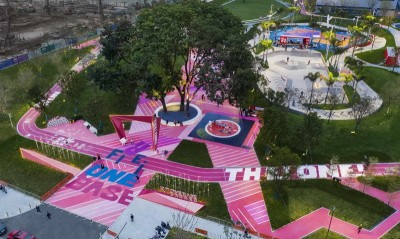
In urban construction, leftover parcels of land often sit idle due to their limited size. In August 2018, Chongqing launched an initiative to transform such vacant plots into community sports and culture parks, planning to build 92 of them by 2020. Designed by GVL Landscapes, Chongqing Xinhu North Sports and Culture Park is among the first batch of completed corner parks. Located in the northern part of Dadukou District at the intersection of Shuangyuan Road, Shanchuan Road, and Shanhe Road, the park is surrounded by dense residential neighborhoods that previously lacked large public activity spaces. Drawing on the actual needs of local residents, the design team leveraged existing site resources to create a community park centered on sports and culture, serving people of all ages. The site occupies 20,452 square meters, measuring roughly 140 meters east-west and 170 meters north-south, with significant topographic variation—the elevation difference between the highest and lowest points reaches 13.5 meters. Respecting the original hilly terrain, the team designed earthwork balancing on the existing grade, using gentle slopes, lawns, and hedges instead of retaining walls to preserve the mountainous character. Permeable pavement facilitates stormwater drainage, while a former puddle has been converted into a sand play area surrounded by drainage ditches. Stepped seating beside the sand pool allows parents to supervise their children from above. Chongqing is known as one of China's furnace cities. During site analysis, the team discovered that shadows cast by surrounding residential buildings naturally shade the park, and that peak visitation occurs during morning and evening hours. This insight guided the placement of landscape functions in relation to local sunlight patterns: the children's playground is situated in well-ventilated areas that receive ample winter sun and summer shade, while fitness equipment is arranged east-west facing north, paired with deciduous shade trees to accommodate seasonal needs. A central corridor inspired by traditional Chinese blessing garments collected from families creates a friendly gathering space with fresh colors and an elegant structure. The design team drew on the traditional role of covered walkways in Chinese gardens, using them to connect and lead visitors through the park. Tree groves are arranged to evoke the scale and character of traditional Chongqing streetscapes. Since opening, the park has welcomed an average of 3,300 visitors per day, drawing not only nearby residents but also sub-district offices and schools that host community events here. What was once idle land has become a shared public space that fosters social interaction and enriches daily life. Corner parks like this one play an important role in adding urban open space, improving city image, and advancing the development of a park city.





 Editor's Pick
 Latest Design