Text description provided by the architects
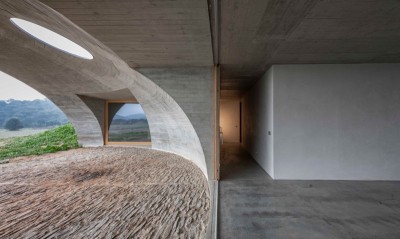
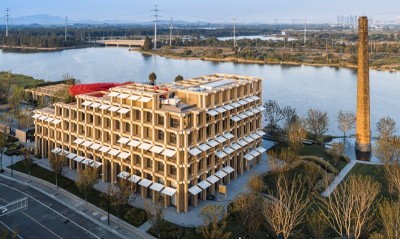
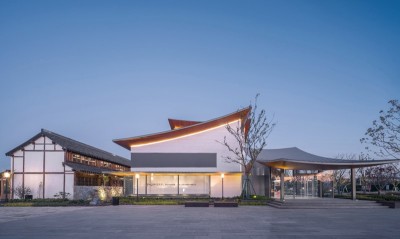
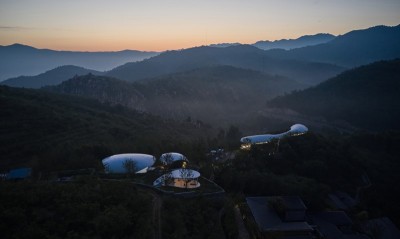
Set on more than a thousand mu of karst terrain at 1,100 metres elevation on Fairy Mountain in Wulong, Chongqing, the Guiyuan Town development is built around the century-old Jingzhu Village and is organised by the goal of reviving the countryside while preserving rural nostalgia. With forests, grasslands, tiankeng sinkholes, gorges, peaks and cliffs, the site is extraordinarily rich in landform; WTD approaches every move from three simultaneous readings of people, place and scenery, and in this case the dramatic terrain and the social distance between visitors and locals demand an even more restrained hand. A restored old farmhouse becomes a restaurant on a short slope that drops to a cliff and a tiankeng; the team rebuilds a cour d'honneur of rough local stone and adds a timber platform that extends human activity to the cliff edge, leaving a small level change that becomes a ring of dry-stone bench. The space is deliberately left undefined, so that time and the visitors themselves decide what it becomes. A deep tiankeng flanked by a cliff and a sloping pine forest is treated as a natural theatre and climbing crag; rather than imposing a programme, the team only introduces behaviour with a cliffside path through the pines and a winding ramp down to the sinkhole floor, leaving the rock and vegetation as they have stood for millennia. In the quietest part of the pine forest a single pavilion is placed with minimal intervention, a place to stop, breathe the negatively charged air and recover one's centre. The project respects the local terraces built by villagers in hard-won patches on thin slopes, and continues to plant the only crop that thrives here: small but exceptionally sweet waxy corn, grown as much for memory as for harvest. Water is led through the site as dry creek beds guided by exposed rock, so that in rainy season they become streams and in dry season they become playgrounds. Bamboo, the everyday material of local farmhouses, is reactivated: villagers are invited back to weave fences alongside the design team, and several types of bamboo pavilion and corridor are developed so that familiar craft is given new life. Built by interior designers Shangyiyang and landscape architects WTD for investor Fance Holdings, with architecture by Shenzhen Chenggou and Shanghai Dachuan, the project won the 2017 Gold Pan Award for Best Tourist Resort in Southwest China and nationally. It is still under construction, and the completed portions already show a quiet harmony between land, native scenery, villagers and arriving visitors.




 Editor's Pick