Text description provided by the architects
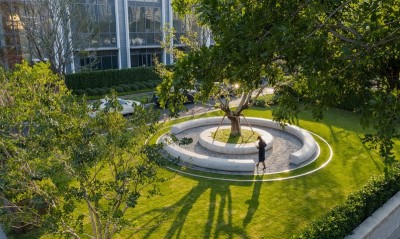
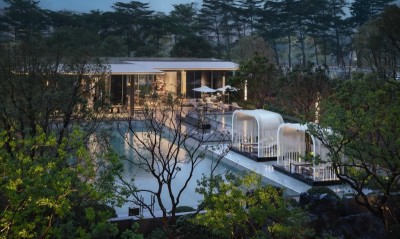
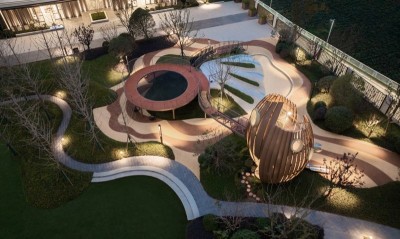
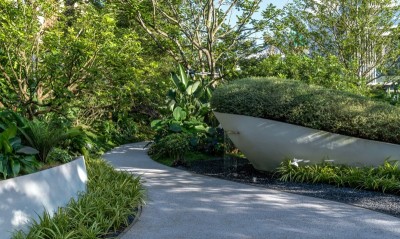
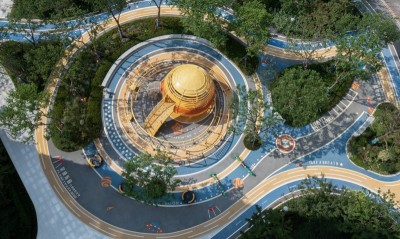
Sunac Lin Yu Lu in Chongqing is an urban residential project on a 170-meter-deep north-south site with a maximum elevation change of about 15 meters, organized as six stepped terraces with buildings arranged parallel and regular. An axis running north-south through the middle of the site connects the six terraces and, enjoying ample sunlight year-round, becomes the primary community activity area and the heart of the landscape design. VITA Scene, the local Chongqing landscape practice, has long engaged with mountainous terrain; here it treats the ascending spatial sequence as a continuous ordered composition, inspired by the colors of mountain forests. If a mountain is read as a three-dimensional painting, vegetation shifts with altitude: deep green pools, broad forest green, moss green, ginger-red branches, golden leaves and pale white clouds. The design breaks spatial boundaries by likening the axis to a natural scroll painting of mountain forest, producing one realm per level and one color per tier, each step revealing a different hue. Green serves as the base tone, mysterious and deep. The entrance is themed jade green, conceived as a ring-shaped artistic space like the vestibule of a natural exhibition hall. On a pure white base, a pool, layered forest and tree shadows introduce color. Working from the architect's entrance gate shaped like a flying egret, the team added a hollow circular courtyard centered on a water feature. The ring's perforated top admits light; its double-loaded outer facade is built from equal-scale stacked walls that reinforce a sense of sequence. Araucaria trees pierce through the ring, their coniferous green contrasting with white walls and blue sky. At night, a mirrored ring light above the water echoes a galaxy. The water surface is still yet turbulent, with flow accelerating from outside to center like a calm vortex. Paving traces star-orbit lines in intersecting and separating complex geometries, punctuated by nebula and galaxy-themed sculptures. The result is a differentiated urban interface at the foot of the hill, translating mountain forest into a landscape appreciation grounded in a minimalist, pure base.




 Editor's Pick
 Latest Design