Text description provided by the architects
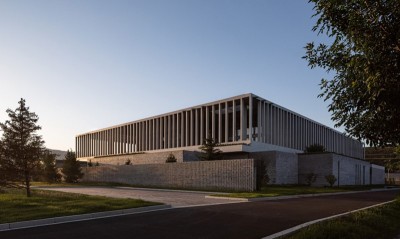
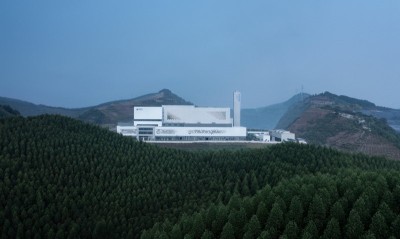
The Nanning Shuangding Waste-to-Energy Power Plant, located twenty kilometers northwest of the city among eucalyptus forests and in front of karst peak clusters, was designed by UUA Architects under partners Li Yongzheng and Li Qizhi, with overall design by China Urban Construction Design and Research Institute. The 54,000-square-meter plant, processing 3,000 tons per day from 2020 to 2022, reimagines a stigmatized industrial type as a contemporary landmark. The design enters through circular economy and carbon neutrality: incineration converts waste to carbon dioxide and heat far faster than landfill, avoids methane from decomposition, and displaces coal through recovered electricity, a double carbon-reduction strategy. To win public acceptance, the new generation of plant must pair advanced technology with public-facing aesthetics and visitor programs, dissolving the boundary between industrial and public space. Nanning's identity as the Green City, its multi-ethnic folk culture and its dramatic karst peaks provide the design vocabulary; arriving on site, the team was struck by a contrast of lush greenery against a bare, flattened plateau to the north, where a cement quarry had sheared off the mountain. The 200-meter-wide, 55-meter-tall main facade is designed to visually complete that damaged ridge: undulating peak-cluster forms generated by four superimposed trigonometric curves rise across the upper facade, closing the mountain range that human activity had broken. Up close, the vertical fins read like zhuang brocade embroidery. The upper envelope alternates mirrored and matte aluminum louvers, each fin bent in a single direction on the parametric curve so that a three-dimensional surface is achieved at low cost, while triangle glass ribs with white frit dots scatter daylight inside. The podium uses horizontal aluminum bands simplified into triangular facets. The facade shifts with angle, light and weather, easing the mass's pressure on the ground. Inside, the waste-handling process itself is presented as a machine aesthetic: trucks unload into a negative-pressure pit, leachate is treated, cranes feed the furnaces, flue gas is cleaned to national standards, and heat drives steam turbines into the grid. The result is a work of rigorous engineering discipline fused with artistic response to site and culture.




 Editor's Pick
 Latest Design
 Best Idea