Text description provided by the architects
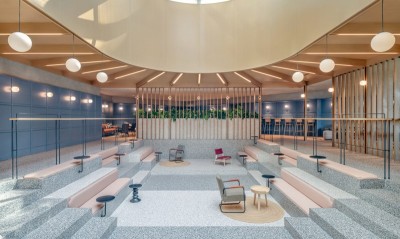
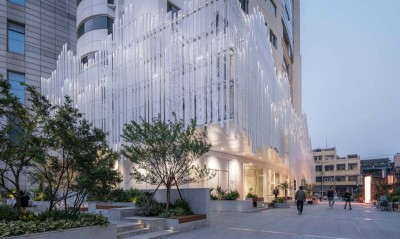
The Jixiang Street urban renewal project in Wanzhou, Chongqing, is a government-led intervention in one of China's most characteristic mountain cities. Old Wanzhou is threaded by narrow, steep alleyways whose living fronts have fallen into disrepair, whose public life has drained away, and whose residents have gradually left. The district administration sought a pilot that could demonstrate how a single small street could catalyse wider organic renewal. The chosen site sits precisely at the interface between new and old: backed by a half-mountain residential quarter of aged alley housing, fronting the busy Wanda commercial street, and connected upward to the historic Xingshu Compound, it is a small triangular residual space bounded by two long, dim service tunnels. The design strategy, developed by WTD, builds on lessons from the Mengzhuiwan project in Chengdu: preserve the existing fabric, serve local residents first, and introduce selective commercial programming to draw in younger users. Existing walls, trees, and the site's yellow banyan are retained and reinterpreted; around the ancient tree, a moonlit theatre, urban bookroom, and reading nook are formed, with outdoor bar counters and seating extending usable area. Unavoidable anti-slip bollards, a concrete biogas pit, and tangled utility lines are clad in perforated aluminium panels to become a cultural wall for the theatre. A terrazzo grand stair resolves the site's level changes and doubles as stepped seating. Commercial uses are distributed as point interventions rather than a continuous ground-floor strip: a cafe occupies a small volume whose corner is deliberately cut away to spare an ancient tree; street vending and flexible market stalls inject informal life. Cultural memory is layered into the site: a translucent arch woven from 300,000 steel wires marks the threshold to the old street; perforated steel walls along the tunnels reflect silhouettes of the old Wanzhou port and Xishan Clock Tower, backlit at night; a moon wall traces the lunar cycle to evoke locals' childhood memories of moonlight on the Yangtze. Existing blue-stone paving, steps, and alley widths are preserved, with glowing glass blocks guiding visitors. The rear elevation of the Wanda commercial building keeps most of its original masonry, now contrasted with modern glass and steel. Completed in 2021 under the commission of the Wanzhou Housing and Urban-Rural Development Commission, the project argues that successful old-district renewal must anchor commerce in everyday life, preserve the social fabric, and let point interventions trigger a network of self-organized regeneration across the wider old city.




 Editor's Pick
 Latest Design