Text description provided by the architects
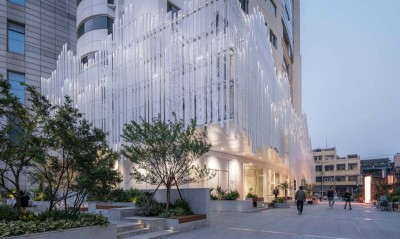
Set in the deep Wuling Mountains where the Dafeng Primeval Forest preserves an eighty-four percent forest cover, Zhongyi Township in Shizhu Tujia Autonomous County, Chongqing, is a remote settlement of extraordinary ecological and ethnic richness. Long famed for mountain honey and the medicinal herb huanglian, the valley was constrained by its folded terrain of two ranges sandwiching a narrow trough. Presented as a joint philanthropic undertaking between the developer Sunac and Tsinghua University, the project reframes rural revitalization through party-led governance, industry, cultural activation and green development, and is treated by landscape architect WTD as an experiment in long-term co-built rural stewardship. Four programmatic anchors are strung along the township road in an L-shaped route: the Chuxin Academy, the Bizi Kari market, the Chinese Honeybee Valley and the Banxiang original homestay. To the west, a route themed on revisiting sweet years threads through apiaries; to the south, a route on experiencing Tujia mountains and water draws visitors into a full-cycle cultural tourism system built around local agriculture and beekeeping. The academy, a party-school training base beneath dense woodland, is given ceremonial weight through a rough-stone corridor leading to a still pool beneath a perforated circular roof that frames sky, forest and mountain, while a long axial walkway and a mirroring water court reflect the surrounding ranges. At Bizi Kari, named for the Tujia autonym meaning indigenous people, two koi-shaped buildings enclose a small plaza with an open-air folk stage, their interiors housing crafts, produce, regional food and ethnic performance. The Honeybee Valley reworks an underused tiered-terrace homestay precinct with local bamboo and tile, a tea pavilion at the terrace crest, lotus planting, straw figures recalling field labor, and a Tujia folk theater built from traditional block stone. At Banxiang, a century-old courtyard is retained, its structure preserved and its roofs and timbers renewed in local materials; circulation between buildings is reorganized with viewing platforms and edible paddy landscapes. By anchoring tourism in existing agricultural and cultural assets, the design aims to activate endogenous rural income and offer a transferable model for sustained village renewal.




 Editor's Pick
 Latest Design