Text description provided by the architects
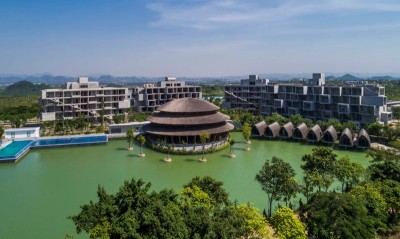
The site lies in a valley in the Rehe region, north of Chengde, in an original forest environment where massive volcanic eruptions occurred in ancient times, giving the area naturally superior hot-spring resources. Hot springs have always existed, but most served locals; the project aims to provide a place for busy, fast-paced urban dwellers to completely relax, combining hot springs with plants to create a healing experience different from existing local offerings. The team walked the entire valley and climbed to observe, finally choosing the inflection point deep in the center of the valley, surrounded by mountains, backed by slopes and facing water: a naturally quiet place. During site walks, some parts of the valley were bright, others suddenly dark, and the temperature on the hillside rose and fell; at times the clear sound of running water, at times birdsong. The designer planned to integrate this free, open experience of walking through the natural forest into the design, which is the concept of Forest Valley. The design interleaves the two main functional spaces of hot springs and plants, combining tall vertical solid towers with horizontal transparent glass boxes to echo the rolling mountains and create valley-like spatial variation. There are eight towers of varying heights and angles: on the ground floor, two towers contain soaking pools and the others service spaces; on the second floor, the eight towers house two spas, five soaking pools, and one rest area, while outside the towers, glass boxes enclose large open planted landscape zones. The eight towers are connected on the ground floor by strolling paths and on the second floor by sky bridges, forming closed loops without endpoints that offer many freely selectable routes, so people feel as if they are walking in a forest. Along the routes, small functions such as cafe, rest, makeup, and shop are scattered, enriching the walking experience. Inside the towers, large picture windows let bathers look out at thick snow or green leaves, or through skylights see airplanes crossing the sky or sparkling stars; stepping out onto the bridges among the treetops is also a pleasant forest walk. To express the miraculous energy of nature, the exterior walls of the towers use volcanic rock, because both volcanic rock and hot springs are products of volcanic eruptions. Volcanic stone is layered on like mountain vegetation; the horizontal glass boxes contrast the solid towers with transparent voids. Interiors mainly use bamboo, raw wood, and stone, arranged in four different patterns combined with lighting and the depth of the towers to create a special soaking ritual. In modern fast-paced city life, functions like hot springs become increasingly important. When people remove their clothes, the clutter of the outside world, and their social identities, appearing nearly naked in this space, they return to a primitive state, and communication between people and nature, and between people, becomes honest and real. Forest Valley Hot Spring Center is a new place for modern urbanites to encounter nature and one another.




 Editor's Pick
 Latest Design
 Best Idea