Text description provided by the architects
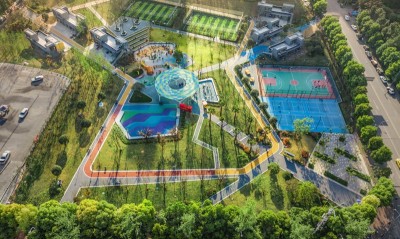
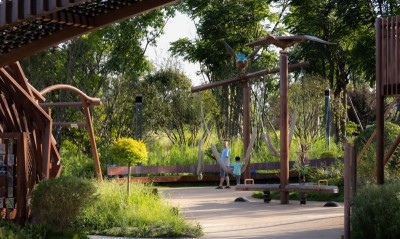
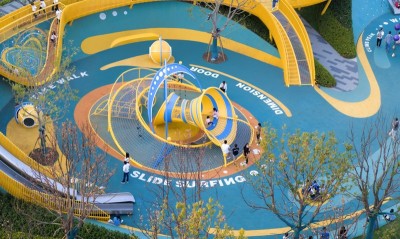
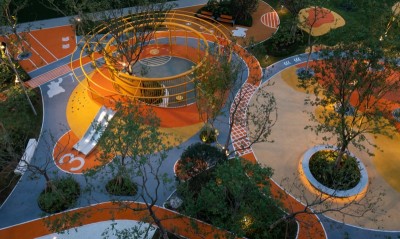
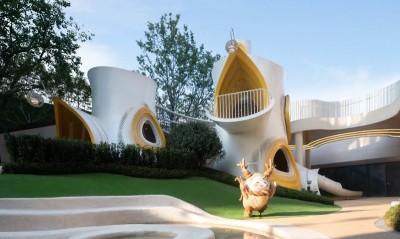
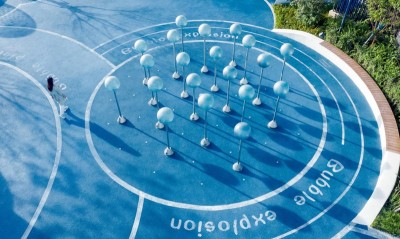
On the central axis facing the main entrance of Poly East County PRO in Guangzhou's Guanggang New Town, a children's play field occupies a visual focal point visible from high-rise windows and across a planted earth mound. Continuing Poly's Planet series, the brief was Mars exploration. Rejecting the literal cliché of rockets and spaceships placed anywhere, the designers drew on the collective memory of the 2015 film The Martian: vast red rock and dune terrain, cratered alien ground. Digital terrain modeling, by Xisui Design, differentiates zones for younger and older children according to slope and complexity, burying rich play apparatus within the earth. Programmatic drainage ensures no local ponding: all rainwater flows naturally to surrounding green buffers and peak-drainage inlets, so the EPDM surface needs no drainage outlets. The architectural challenge is a undulating concrete thin-shell that forms caves following the terrain, offering climbing above and shelter below—thin shells, studied at ETH Zurich for saving up to seventy percent of material versus traditional beam frames, being a live frontier of digital fabrication. Because the basement roof carries only 1.5 meters of overburden and uses a beamless slab, the design uses partial pilotis and foam backfilling to reduce loads and control differential settlement, with inverted beams spreading the shell's feet. Red dominates the EPDM palette to evoke Mars and energize running and jumping, while blue is used as a complementary tone to prevent the overall red from turning yellowish and restless. An independent preschool zone on the east offers gentle slopes, small slides, climbing grips and balance beams; the west serves school-age and all-ages children with climbing walls, rope courses, crawling tubes, activity capsules, tubular and straight slides, balance trails, trampolines and rubber-ring ramps. Five Viewing Planets offer different climbing routes, their perforated surfaces referencing the five Chinese elements—oval, strip, round, triangle, square—corresponding to Venus, Jupiter, Mercury, Mars and Saturn. A Mars landing module stands independently in a shell skylight, climbed from below or entered through a side porthole, then descended by a large tubular slide. The 1,300-square-meter field was designed in November 2019 and completed in August 2022.




 Editor's Pick
 Latest Design
 Best Idea