Text description provided by the architects
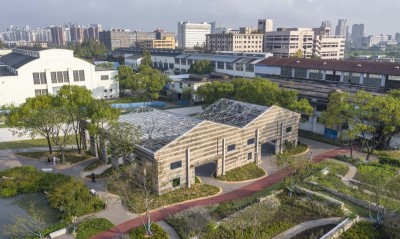
Greenland Hong Kong Yejin Dongnan in Yangzhou is an adaptive reuse of the former Yangzhou Metallurgical Machinery Plant, a 61-year-old industrial site transformed into a mixed-use cultural and residential quarter that local media have already dubbed Yangzhou's answer to Beijing's 798. The factory was founded in 1958 as a small municipal electrical works with eighteen employees; by the 1980s it had grown into one of Yangzhou's largest metallurgical-equipment manufacturers and top taxpayers; it was restructured as a limited company in 1998, privatized in 2004, and finally vacated in 2017 under the city's retreat-from-industry policy. The design brief had to reconcile three often conflicting demands: a government looking for harmonious, ecological urbanism, residents searching for memory and future promise, and a developer balancing brand and profit. Early sketches piled generic luxury gestures onto the site, but a site visit, towering metasequoia, dust-covered machine tools, rough brick walls and creeper-draped facades, forced a conceptual pivot. The team articulated three strategies: preserve industrial traces and let the city's industrial lineage continue in space; introduce art as a catalyst that rebuilds community belonging; and link people and ecology in a sustainable future. The former metallurgical canteen becomes the sales gallery, its distinctive brick facade kept largely intact, with seven tall metasequoia retained on the side; a still water feature in front, faced with weathering steel, reflects the red brick and turns the industrial remnant into an almost waterborne object. Reclaimed timber cylinders, red-brick sculpture and casual tree pits invite interaction with neighbours. The former office block becomes a commercial street: original machine tools are displayed as museum pieces, and a time corridor of milestones from the factory history recovers the memory of the old factory newspaper and award certificates. One facade is rebuilt from reclaimed grey brick in a parametric perforated pattern, and a time sculpture marking the founding year 1958 uses the same recycled red brick. A lotus-pond motif is reborn as an interactive light-sensing fountain that activates when children run across the dry plaza. A planted flower-border path along the rear passage softens the former brownfield, turning industrial wasteland into livable green. The project links the southeast district's industrial memory to its domestic future, becoming a new cultural landmark for Yangzhou.




 Editor's Pick
 Latest Design